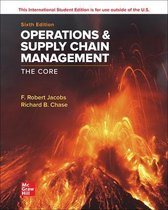
Test Bank - Operations and Supply Chain Management The Core 6th Edition (Jacobs, 2023)
TEST BANK
Operations and Supply Chain Management
The Core
F. Robert Jacobs, Richard B. Chase
6th Edition
, Test Bank - Operations and Supply Chain Management The Core 6th Edition (Jacobs, 2023)
Table of Contents
1. Introduction to OSCM
2. Strategy and Sustainability
3. Forecasting
4. Strategic Capacity Management
4a. Learning Curves
5. Projects
6. Manufacturing Processes
6a. Break-Even Analysis
7. Service Processes
8. Sales and Operations Planning
9. Material Requirements Planning
10. Quality Management and Six Sigma
11. Inventory Management
12. Lean Supply Chains
13. Global Sourcing and Procurement
14. Location, Logistics, and Distribution
, Test Bank - Operations and Supply Chain Management The Core 6th Edition (Jacobs, 2023)
CHAPTER 1
1) Which of the following is a reason for studying operations and supply chain management
(OSCM)?
A) OSCM is essential for understanding organizational behavior.
B) Most business graduates do OSCM work regardless of their job title.
C) All managers should understand the basic principles that guide the design of
transformation processes.
D) OSCM is a required course in all business degree programs.
E) OSCM is the most rigorous business discipline.
2) Which of the following sets of categories the Goods-Services Continnuum consists of?
A) No goods, some goods, even mix, some service, no service.
B) Pure goods, core goods, core services, pure services.
C) No service, some service, good service, excellent service.
D) Self-service, help desk service, face-to-face service, service-with-a-smile.
E) None of these.
3) Which of the following are defined as core goods?
A) Chemicals.
B) Airlines.
C) Data storage systems.
D) Hotels.
E) None of these.
4) Current issues in OSCM do not include _____________blank.
Version 1 1
Page 3
, Test Bank - Operations and Supply Chain Management The Core 6th Edition (Jacobs, 2023)
A) coordinating relationships between organizations
B) making senior management aware that OSCM can be a competitive weapon
C) managing customer touch points
D) increasing global supply chain employment
5) Which of the following are not listed in the text as jobs in OSCM?
A) Department store manager.
B) Project manager.
C) Hospital administrator.
D) Data center manager.
E) Call center manager.
6) Which of the following is not a characteristic that distinguishes services from goods?
A) Service jobs are unskilled.
B) A service is intangible.
C) Services are perishable.
D) Services are heterogeneous.
E) None of these.
7) Which of the following is not a way that operations and supply processes are
categorized?
A) Planning.
B) Returning.
C) Delivering.
D) Selecting.
E) Making.
Version 1 2
Page 4
, Test Bank - Operations and Supply Chain Management The Core 6th Edition (Jacobs, 2023)
8) One of the "package of features" that makes up a service is _____________blank.
A) appearance.
B) facilitating goods.
C) packaging.
D) cost.
E) implied use.
9) Which of the following is not a measure of operations and supply chain management
efficiency used by Wall Street?
A) Inventory turnover.
B) Days inventory.
C) Receivable turnover.
D) Earnings per share.
E) Asset turnover.
10) Which of the following is a measure of operations and supply management efficiency
used by Wall Street?
A) Dividend payout ratio.
B) Current ratio.
C) Receivables turnover.
D) Earnings per share growth.
E) Financial leverage.
11) Managing customer touch points becomes a concern under current issues in OCSM when
_____________blank.
Version 1 3
Page 5
, Test Bank - Operations and Supply Chain Management The Core 6th Edition (Jacobs, 2023)
A) complaints arise about shaking hands with customers in cultures that is frowned upon
B) firms striving to become superefficient begin to scrimp on staffing and training
customer support personnel
C) a firm has a workforce trained in specifically diverse situations and the correct level of
service may be hard to discern
D) firms market global products
E) senior executives fail to recognize the contribution OCSM can make to their success
12) When considering the concept of value, how is quality defined?
A) By the price of the product.
B) By the producer’s reputation in the industry.
C) By the weight of the product.
D) By the attractiveness of the product, considering its features and durability.
E) By the product’s uniqueness relative to other similar products.
13) All other things remaining the same, if the revenue or sales decreases, asset turnover ratio
will _____.
A) decrease
B) increase
C) stay the same
D) will decrease, but the amount of change will depend on the profit margin
E) decrease and will decrease, but the amount of change will depend on the profit margin
Version 1 4
Page 6
, Test Bank - Operations and Supply Chain Management The Core 6th Edition (Jacobs, 2023)
14) Which of the following is the most appropriate regarding inventory turnover?
A. Inventory turnover increases as average inventory decreases, while other things remain the
same.
B. Inventory turnover is an efficiency measure.
C. Inventory turnover is unaffected by changes in annual sales.
A) Choice A
B) Choice B
C) Choice C
D) Choices A and B only
E) Choices A, B and C will hold
15) Identify the most appropriate answer regarding cash conversion cycle.
A. Is also known as cash-to-cash cycle.
B. Cash conversion cycle goes down if payable period goes up.
C. Cash conversion cycle goes up if average inventory goes up.
A) Choice A
B) Choice B
C) Choice C
D) Choices A and B are correct
E) Choices A, B and C are all correct
16) Efficiency means doing the right things to create the most value for the company.
⊚ true
⊚ false
Version 1 5
Page 7
, Test Bank - Operations and Supply Chain Management The Core 6th Edition (Jacobs, 2023)
17) Effectiveness means doing the right things to create the most value for the company.
⊚ true
⊚ false
18) A doctor completes a surgical procedure on a patient without error. The patient dies
anyway. In operations management terms, we could refer to this doctor as being efficient but not
effective.
⊚ true
⊚ false
19) A worker can be efficient without being effective.
⊚ true
⊚ false
20) A process can be effective without being efficient.
⊚ true
⊚ false
21) Operations and supply chain management is defined as the design, operation, and
improvement of the systems that create and deliver the firm's primary products and services.
⊚ true
⊚ false
22) The term "value" refers to the relationship between quality and the price paid by the
consumer.
⊚ true
⊚ false
Version 1 6
Page 8
, Test Bank - Operations and Supply Chain Management The Core 6th Edition (Jacobs, 2023)
23) Attempting to balance the desire to efficiently use resources while providing a highly
effective service may create conflict between the two goals.
⊚ true
⊚ false
24) Central to the concept of operations strategy are the concepts of operations focus and
trade-offs.
⊚ true
⊚ false
25) OSCM is concerned with management of the trickiest parts of the system that produces a
good or delivers a service.
⊚ true
⊚ false
26) OSCM is a functional field of business with clear line management responsibilities.
⊚ true
⊚ false
27) The supply network can be thought of as a pipeline through which cash, material, and
information flow.
⊚ true
⊚ false
28) Supply networks cannot be constructed for every product or service.
⊚ true
⊚ false
Version 1 7
Page 9
, Test Bank - Operations and Supply Chain Management The Core 6th Edition (Jacobs, 2023)
29) "Operations" refers to manufacturing and service processes used to transform resources
employed by a firm into products desired by customers.
⊚ true
⊚ false
30) "Supply Chain" refers to processes that move information and material to and from the
manufacturing and service processes of the firm.
⊚ true
⊚ false
31) "Supply Chain" includes only inbound freight and inventory.
⊚ true
⊚ false
32) It is critical that a sustainable strategy meet the needs of shareholders and employees. It is
also highly desirable that it preserves the environment.
⊚ true
⊚ false
33) Planning is where a firm must determine how anticipated demand will be met with
available resources.
⊚ true
⊚ false
34) Although planning involves determining how the various supply chain processes
(sourcing, making, delivering, and returning) will be met, planning itself is not considered a
supply chain process.
⊚ true
⊚ false
Version 1 8
Page 10
TEST BANK
Operations and Supply Chain Management
The Core
F. Robert Jacobs, Richard B. Chase
6th Edition
, Test Bank - Operations and Supply Chain Management The Core 6th Edition (Jacobs, 2023)
Table of Contents
1. Introduction to OSCM
2. Strategy and Sustainability
3. Forecasting
4. Strategic Capacity Management
4a. Learning Curves
5. Projects
6. Manufacturing Processes
6a. Break-Even Analysis
7. Service Processes
8. Sales and Operations Planning
9. Material Requirements Planning
10. Quality Management and Six Sigma
11. Inventory Management
12. Lean Supply Chains
13. Global Sourcing and Procurement
14. Location, Logistics, and Distribution
, Test Bank - Operations and Supply Chain Management The Core 6th Edition (Jacobs, 2023)
CHAPTER 1
1) Which of the following is a reason for studying operations and supply chain management
(OSCM)?
A) OSCM is essential for understanding organizational behavior.
B) Most business graduates do OSCM work regardless of their job title.
C) All managers should understand the basic principles that guide the design of
transformation processes.
D) OSCM is a required course in all business degree programs.
E) OSCM is the most rigorous business discipline.
2) Which of the following sets of categories the Goods-Services Continnuum consists of?
A) No goods, some goods, even mix, some service, no service.
B) Pure goods, core goods, core services, pure services.
C) No service, some service, good service, excellent service.
D) Self-service, help desk service, face-to-face service, service-with-a-smile.
E) None of these.
3) Which of the following are defined as core goods?
A) Chemicals.
B) Airlines.
C) Data storage systems.
D) Hotels.
E) None of these.
4) Current issues in OSCM do not include _____________blank.
Version 1 1
Page 3
, Test Bank - Operations and Supply Chain Management The Core 6th Edition (Jacobs, 2023)
A) coordinating relationships between organizations
B) making senior management aware that OSCM can be a competitive weapon
C) managing customer touch points
D) increasing global supply chain employment
5) Which of the following are not listed in the text as jobs in OSCM?
A) Department store manager.
B) Project manager.
C) Hospital administrator.
D) Data center manager.
E) Call center manager.
6) Which of the following is not a characteristic that distinguishes services from goods?
A) Service jobs are unskilled.
B) A service is intangible.
C) Services are perishable.
D) Services are heterogeneous.
E) None of these.
7) Which of the following is not a way that operations and supply processes are
categorized?
A) Planning.
B) Returning.
C) Delivering.
D) Selecting.
E) Making.
Version 1 2
Page 4
, Test Bank - Operations and Supply Chain Management The Core 6th Edition (Jacobs, 2023)
8) One of the "package of features" that makes up a service is _____________blank.
A) appearance.
B) facilitating goods.
C) packaging.
D) cost.
E) implied use.
9) Which of the following is not a measure of operations and supply chain management
efficiency used by Wall Street?
A) Inventory turnover.
B) Days inventory.
C) Receivable turnover.
D) Earnings per share.
E) Asset turnover.
10) Which of the following is a measure of operations and supply management efficiency
used by Wall Street?
A) Dividend payout ratio.
B) Current ratio.
C) Receivables turnover.
D) Earnings per share growth.
E) Financial leverage.
11) Managing customer touch points becomes a concern under current issues in OCSM when
_____________blank.
Version 1 3
Page 5
, Test Bank - Operations and Supply Chain Management The Core 6th Edition (Jacobs, 2023)
A) complaints arise about shaking hands with customers in cultures that is frowned upon
B) firms striving to become superefficient begin to scrimp on staffing and training
customer support personnel
C) a firm has a workforce trained in specifically diverse situations and the correct level of
service may be hard to discern
D) firms market global products
E) senior executives fail to recognize the contribution OCSM can make to their success
12) When considering the concept of value, how is quality defined?
A) By the price of the product.
B) By the producer’s reputation in the industry.
C) By the weight of the product.
D) By the attractiveness of the product, considering its features and durability.
E) By the product’s uniqueness relative to other similar products.
13) All other things remaining the same, if the revenue or sales decreases, asset turnover ratio
will _____.
A) decrease
B) increase
C) stay the same
D) will decrease, but the amount of change will depend on the profit margin
E) decrease and will decrease, but the amount of change will depend on the profit margin
Version 1 4
Page 6
, Test Bank - Operations and Supply Chain Management The Core 6th Edition (Jacobs, 2023)
14) Which of the following is the most appropriate regarding inventory turnover?
A. Inventory turnover increases as average inventory decreases, while other things remain the
same.
B. Inventory turnover is an efficiency measure.
C. Inventory turnover is unaffected by changes in annual sales.
A) Choice A
B) Choice B
C) Choice C
D) Choices A and B only
E) Choices A, B and C will hold
15) Identify the most appropriate answer regarding cash conversion cycle.
A. Is also known as cash-to-cash cycle.
B. Cash conversion cycle goes down if payable period goes up.
C. Cash conversion cycle goes up if average inventory goes up.
A) Choice A
B) Choice B
C) Choice C
D) Choices A and B are correct
E) Choices A, B and C are all correct
16) Efficiency means doing the right things to create the most value for the company.
⊚ true
⊚ false
Version 1 5
Page 7
, Test Bank - Operations and Supply Chain Management The Core 6th Edition (Jacobs, 2023)
17) Effectiveness means doing the right things to create the most value for the company.
⊚ true
⊚ false
18) A doctor completes a surgical procedure on a patient without error. The patient dies
anyway. In operations management terms, we could refer to this doctor as being efficient but not
effective.
⊚ true
⊚ false
19) A worker can be efficient without being effective.
⊚ true
⊚ false
20) A process can be effective without being efficient.
⊚ true
⊚ false
21) Operations and supply chain management is defined as the design, operation, and
improvement of the systems that create and deliver the firm's primary products and services.
⊚ true
⊚ false
22) The term "value" refers to the relationship between quality and the price paid by the
consumer.
⊚ true
⊚ false
Version 1 6
Page 8
, Test Bank - Operations and Supply Chain Management The Core 6th Edition (Jacobs, 2023)
23) Attempting to balance the desire to efficiently use resources while providing a highly
effective service may create conflict between the two goals.
⊚ true
⊚ false
24) Central to the concept of operations strategy are the concepts of operations focus and
trade-offs.
⊚ true
⊚ false
25) OSCM is concerned with management of the trickiest parts of the system that produces a
good or delivers a service.
⊚ true
⊚ false
26) OSCM is a functional field of business with clear line management responsibilities.
⊚ true
⊚ false
27) The supply network can be thought of as a pipeline through which cash, material, and
information flow.
⊚ true
⊚ false
28) Supply networks cannot be constructed for every product or service.
⊚ true
⊚ false
Version 1 7
Page 9
, Test Bank - Operations and Supply Chain Management The Core 6th Edition (Jacobs, 2023)
29) "Operations" refers to manufacturing and service processes used to transform resources
employed by a firm into products desired by customers.
⊚ true
⊚ false
30) "Supply Chain" refers to processes that move information and material to and from the
manufacturing and service processes of the firm.
⊚ true
⊚ false
31) "Supply Chain" includes only inbound freight and inventory.
⊚ true
⊚ false
32) It is critical that a sustainable strategy meet the needs of shareholders and employees. It is
also highly desirable that it preserves the environment.
⊚ true
⊚ false
33) Planning is where a firm must determine how anticipated demand will be met with
available resources.
⊚ true
⊚ false
34) Although planning involves determining how the various supply chain processes
(sourcing, making, delivering, and returning) will be met, planning itself is not considered a
supply chain process.
⊚ true
⊚ false
Version 1 8
Page 10