Edrftgyihu jiuh
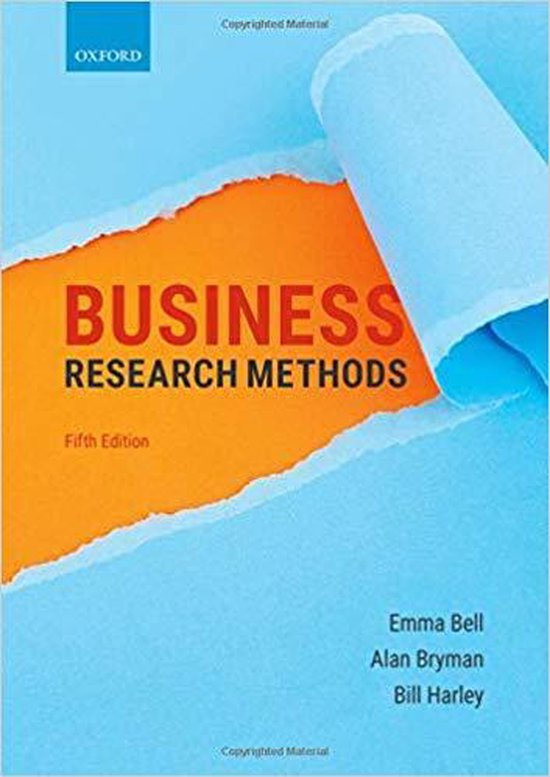
Business Research
Methods, 5th Edition
ST
UV
CASE NOTES
IA
MANUAL
_A
Emma Bell
PP
Alan Bryman
Bill Harley
────────────────────────────────────────────────────
RO
Comprehensive Case Notes Manual for
Instructors and Students
VE
||| ||| || ||| || | || ||| | || ||| |
9780198809876
D?
© Emma Bell, Alan Bryman, & Bill Harley. All rights
reserved. Reproduction or distribution without permission is
prohibited.
© MEDGEEK
, Edrftgyihu jiuh
Business Research Methods — Case Notes Manual
Emma Bell, Alan Bryman and Bill Harley
ISBN: 9780198809876
ST
Chapter 1: The nature and process of business research
Chapter 2: Business research strategies
Chapter 3: Research designs
Chapter 4: Planning a research project and developing research questions
UV
Chapter 5: Getting started: reviewing the literature
Chapter 6: Ethics in business research
Chapter 7: Writing up business research
Chapter 8: The nature of quantitative research
Chapter 9: Sampling in quantitative research
Chapter 10: Structured interviewing
IA
Chapter 11: Self-completion questionnaires
Chapter 12: Asking questions
Chapter 13: Quantitative research using naturally occurring data: structured observation and
content analysis
_A
Chapter 14: Secondary analysis and official statistics
Chapter 15: Quantitative data analysis
Chapter 16: Using IBM SPSS statistics
Chapter 17: The nature of qualitative research
Chapter 18: Sampling in qualitative research
PP
Chapter 19: Ethnography and participant observation
Chapter 20: Interviewing in qualitative research
Chapter 21: Focus groups
Chapter 22: Language in qualitative research
Chapter 23: Documents as sources of data
RO
Chapter 24: Qualitative data analysis
Chapter 25: Computer-assisted qualitative data analysis: using NVivo
Chapter 26: Breaking down the quantitative/qualitative divide
Chapter 27: Mixed methods research
VE
D?
© MEDGEEK
, Bell, Bryman & Harley: Business Research Methods, 5th edition
Case 1. Content analysis
A content analysis of universities’ and further education colleges’
Twitter usage
ST
Introduction
Despite its popularity and growth, recent research suggests that organizations are
UV
not successfully utilizing social media to conduct dialogic communication (Rybalko
and Seltzer, 2010) and therefore there are queries whether social media can be an
effective relationship-building tool (Taylor and Kent, 2010). This study explored how
IA
universities used Twitter deploying Kent and Taylor’s (2002) five principles of dialogic
communication. These principles are as follows: a) the dialogic loop b) the
usefulness of information c) generation of return visits d) ease of interface and e) the
_A
conservation of visitors.
Research questions
PP
The first research question was ‘Which dialogic principles are present in the
individual Tweets of Colleges and Universities in the United States?’ The second
research questions asked ‘Which publics are targeted in the individual tweets of
RO
major universities and colleges in the United States’. The third and last research
question was ‘Do universities employ the principles of dialogic communication to a
different degree than do liberal arts colleges?’
VE
Methods
The researchers chose every third institution listed in the United States News and
D?
World Reports (2012) of the best colleges and universities. The sample size was
initially 133 institutions in total. Researchers then visited Twitter.com to see if each of
these institutions had an active Twitter profile. Profiles were considered active if they
, Bell, Bryman & Harley: Business Research Methods, 5th edition
had tweeted within one week of 13 October 2011. This criterion gave a final sample
of 113 institutions (60 national universities and 53 liberal arts colleges). The ten most
recent tweets for each of these institutions posted on or before 13 October 2011
were then sampled for inclusion in the study producing a total of 1130 tweets. The
ST
date was chosen in an attempt to represent a typical week on Twitter for a college or
university. Two of the authors of this study coded all 1130 individual tweets. Each
UV
tweet was first coded for its target audience: Prospective Student, Student, Faculty,
Alumni, or Parents. Individual tweets could be coded for multiple target audiences. If
a target audience was not identified the audience was coded as General. Each
dialogic principle outlined above was then coded as either present or not present. If
IA
present, a category was noted for what qualified that principle as present. The two
coders began with a sub-sample of 100 common tweets. Reliability testing was
_A
performed for each principle using Cohen’s kappa and ranged between .66
(conservation of visitors) and 1.0 (usefulness of information).
PP
Results
An independent sample t-test was conducted to compare the use of each of the four
dialogic principles by both national universities (n = 60) and liberal arts colleges (n =
RO
53). Three of the four principles were employed by national universities to a greater
extent than they were by liberal arts colleges. The key finding of the study was that
the majority (89.1%, 1007 tweets out of 1130) of universities’ Twitter accounts are
VE
directed towards a more general audience. Just 54 tweets (4.8%) were directed
towards prospective students, 69 (6.1%) were directed towards current students, 18
(1.6%) towards faculty, 19 (1.7%) towards alumni and 54 (4.8%) towards parents. It
D?
was also found that 790 (69.9%) of the 1130 tweets contained links; 587 (51.9%) of
these were links to other parts of the institutions’ internet presence. Just 29.5% of
Business Research
Methods, 5th Edition
ST
UV
CASE NOTES
IA
MANUAL
_A
Emma Bell
PP
Alan Bryman
Bill Harley
────────────────────────────────────────────────────
RO
Comprehensive Case Notes Manual for
Instructors and Students
VE
||| ||| || ||| || | || ||| | || ||| |
9780198809876
D?
© Emma Bell, Alan Bryman, & Bill Harley. All rights
reserved. Reproduction or distribution without permission is
prohibited.
© MEDGEEK
, Edrftgyihu jiuh
Business Research Methods — Case Notes Manual
Emma Bell, Alan Bryman and Bill Harley
ISBN: 9780198809876
ST
Chapter 1: The nature and process of business research
Chapter 2: Business research strategies
Chapter 3: Research designs
Chapter 4: Planning a research project and developing research questions
UV
Chapter 5: Getting started: reviewing the literature
Chapter 6: Ethics in business research
Chapter 7: Writing up business research
Chapter 8: The nature of quantitative research
Chapter 9: Sampling in quantitative research
Chapter 10: Structured interviewing
IA
Chapter 11: Self-completion questionnaires
Chapter 12: Asking questions
Chapter 13: Quantitative research using naturally occurring data: structured observation and
content analysis
_A
Chapter 14: Secondary analysis and official statistics
Chapter 15: Quantitative data analysis
Chapter 16: Using IBM SPSS statistics
Chapter 17: The nature of qualitative research
Chapter 18: Sampling in qualitative research
PP
Chapter 19: Ethnography and participant observation
Chapter 20: Interviewing in qualitative research
Chapter 21: Focus groups
Chapter 22: Language in qualitative research
Chapter 23: Documents as sources of data
RO
Chapter 24: Qualitative data analysis
Chapter 25: Computer-assisted qualitative data analysis: using NVivo
Chapter 26: Breaking down the quantitative/qualitative divide
Chapter 27: Mixed methods research
VE
D?
© MEDGEEK
, Bell, Bryman & Harley: Business Research Methods, 5th edition
Case 1. Content analysis
A content analysis of universities’ and further education colleges’
Twitter usage
ST
Introduction
Despite its popularity and growth, recent research suggests that organizations are
UV
not successfully utilizing social media to conduct dialogic communication (Rybalko
and Seltzer, 2010) and therefore there are queries whether social media can be an
effective relationship-building tool (Taylor and Kent, 2010). This study explored how
IA
universities used Twitter deploying Kent and Taylor’s (2002) five principles of dialogic
communication. These principles are as follows: a) the dialogic loop b) the
usefulness of information c) generation of return visits d) ease of interface and e) the
_A
conservation of visitors.
Research questions
PP
The first research question was ‘Which dialogic principles are present in the
individual Tweets of Colleges and Universities in the United States?’ The second
research questions asked ‘Which publics are targeted in the individual tweets of
RO
major universities and colleges in the United States’. The third and last research
question was ‘Do universities employ the principles of dialogic communication to a
different degree than do liberal arts colleges?’
VE
Methods
The researchers chose every third institution listed in the United States News and
D?
World Reports (2012) of the best colleges and universities. The sample size was
initially 133 institutions in total. Researchers then visited Twitter.com to see if each of
these institutions had an active Twitter profile. Profiles were considered active if they
, Bell, Bryman & Harley: Business Research Methods, 5th edition
had tweeted within one week of 13 October 2011. This criterion gave a final sample
of 113 institutions (60 national universities and 53 liberal arts colleges). The ten most
recent tweets for each of these institutions posted on or before 13 October 2011
were then sampled for inclusion in the study producing a total of 1130 tweets. The
ST
date was chosen in an attempt to represent a typical week on Twitter for a college or
university. Two of the authors of this study coded all 1130 individual tweets. Each
UV
tweet was first coded for its target audience: Prospective Student, Student, Faculty,
Alumni, or Parents. Individual tweets could be coded for multiple target audiences. If
a target audience was not identified the audience was coded as General. Each
dialogic principle outlined above was then coded as either present or not present. If
IA
present, a category was noted for what qualified that principle as present. The two
coders began with a sub-sample of 100 common tweets. Reliability testing was
_A
performed for each principle using Cohen’s kappa and ranged between .66
(conservation of visitors) and 1.0 (usefulness of information).
PP
Results
An independent sample t-test was conducted to compare the use of each of the four
dialogic principles by both national universities (n = 60) and liberal arts colleges (n =
RO
53). Three of the four principles were employed by national universities to a greater
extent than they were by liberal arts colleges. The key finding of the study was that
the majority (89.1%, 1007 tweets out of 1130) of universities’ Twitter accounts are
VE
directed towards a more general audience. Just 54 tweets (4.8%) were directed
towards prospective students, 69 (6.1%) were directed towards current students, 18
(1.6%) towards faculty, 19 (1.7%) towards alumni and 54 (4.8%) towards parents. It
D?
was also found that 790 (69.9%) of the 1130 tweets contained links; 587 (51.9%) of
these were links to other parts of the institutions’ internet presence. Just 29.5% of