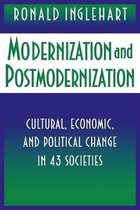
Modernization and postmodernization – Ronald
Inglehart
Cultural, economic, and politi cal change in 43 societi es
Core elements:
Modernization characteristics: urbanization, industrialization, occupational specialization,
mass formal education, development of mass media, secularization, individuation, the rise of
entrepreneurs and entrepreneurial motivations, bureaucratization, the mass production
assembly line, and the emergence of the modern welfare state. material core is
industrialization.
Postmodernization characteristics: emphasis on quality of life, the rise of Postmaterialist
values, greater focus on self-expression and individual autonomy, stronger support for
gender equality and minority rights, environmental awareness, declining trust in traditional
authority and hierarchical institutions, increasing importance of cultural and lifestyle issues in
politics, expansion of higher education and knowledge-based work, and more participatory
forms of democracy. → the material core is the high level of economic security and
technological development created by advanced industrial society.
Introduction
This book examines changes in pollical and economic goals, religious norms and family values, and
explores how these affect economic growth rates, political party strategies, and the prospects for
democratic institutions. Throughout advanced industrial society, freedom of expression and political
participation are becoming more important to more people. The literature on democratic theory
suggests that mass participation, interpersonal trust, tolerance of minority groups, and free speech
are important to the consolidation and stability of democracy. But until recently this was hard to
analyze, this book uses the world values surveys which covers a broader range of variation for
analysing the impact of mass publics on pollical and social life, representing 70 percent of the world's
population and covering the full range of variation. We find remarkably strong linkages between
macrolevel characteristics and microlevel characteristics. The surveys explore the hypothesis that
mass belief systems are changing in ways that have important economic, political and social
consequences. The design of the survey was influenced by the theory of intergenerational value
change: as a result of the rapid economic development and expansion of the welfare state that
followed WWII, the formative experiences of the younger birth cohorts in most industrial societies
differed from those of older cohorts in fundamental ways that were leading them to develop
different value priorities. Throughout history, the threat of severe economic deprivation has been a
crucial concern, but the economic security now in most industrial societies is leading to a gradual
shift from materialist values towards post material priorities. Evidence from the surveys indicates
that this shift is only one component of a much broader cultural shift that displays a large
generational difference, strongly correlated with post materialist values and it mostly moves in a
predictable direction for most societies.
This book argues that economic development, cultural changes, and political change go together in
coherent and even sometimes predictable patterns. It implies that some trajectories of
socioeconomic change are more likely than others and that certain changes are foreseeable. This is
the central claim of Modernization theory, proposed by Marx. The surveys reveal coherent cultural
patterns that are closely linked with economic development. At the same time, it seems clear that
Modernization is not linear. It is above all a process that increases the economic and political
1
,capabilities of a society: it increases economic capabilities through industrialization; and political
through bureaucratization. The core process is industrialization; economic growth becomes the
dominant societal goal. And the achievement motivation becomes the dominant individual-level
goal. The transition from preindustrial to industrial is characterized by the pervasive rationalization of
society, bringing a shift from traditional to rational-legal values.
But modernization is not the final stage, the rise of advanced industrial societies leads to another
shift in values that deemphasizes the instrumental rationality. Postmodern values become prevalent,
bringing a variety of societal changes.
C1 – Value systems: the subjective aspect of politics and
economics
Modernization and Postmodernization
Marx’s idea of social and economic change going together on coherent trajectories is attractive but
controversial. It helps explain changes, but may provide a degree of predictability. Human behaviour
is so complex and influenced by a wide range of factors, operating on so many levels, that any claim
to provide precise, unqualified predictions is likely to go unfulfilled. Nevertheless, certain syndromes
of changes go together in coherent trajectories, with some being more probable than others. The
trajectory Modernization tends to bring long term consequences, such as rising levels of mass
political participation. Thus, although we cant predict actions of specific leaders, we can say that
mass input to politics is likelier to play a decisive role in Sweden than in Albania. This trajectory is
linked with a wide range of other cultural changes. But social change is not linear, although a specific
modernization syndrome of changes is probable when societies move from agrarian to industrial
mode, no trend goes one in the same direction forever, it eventually reaches a point of diminishing
returns. Advanced industrial societies have reached an inflection point and begun moving on a new
trajectory called postmodernization. It reflects a shift in what people want out of life, it represents a
later stage of development that is linked with very different beliefs from those that characterize
modernization.
Modernization theory: the linkages between culture, economics and politics
The central claim: industrialization is linked with specific processes of sociopolitical change that apply
widely. Though preindustrial societies vary, one can meaningfully speak of a model of
modern/industrial society toward which all societies tend to move if they commit to industrialization.
Eco development is linked with a syndrome of changes that includes not only industrialization, but
also urbanization, mass education, occupational specialization, bureaucratization and
communications development, which in turn are linked with broader changes.
There is debate though over the causal linkages: does eco change cause cultural and political change,
or does it work the other way around?
Marx emphasized eco determinism, arguing that a society’s technological level shapes its eco
system, which in turn determines its cultural and political characteristics.
Weber on the other hand emphasized the impact of culture. Its not just a epiphenomenon of
the eco system, but an important causal factor in itself; culture can shape eco behaviour, as
well as being shaped by it. Thus the emergence of the protestant ethic facilitated the rise of
capitalism, which contributed to the Industrial Rev and the democratic rev.
Some of Marx’s successors shifted the emphasis from eco determinism toward greater
emphasis on the impact of ideology and culture. Thus Lenin said that the working class would
2
, never develop sufficient class consciousness for a successful revolution, the need to be led by
an ideologically aware vanguard of professional revolutionaries.
Mao emphasized the power of revolutionary thinking. He held that China need not wait for the
processes of urbanization and industrialization to transform it; if an ideologically committed
cadre could install sufficient enthusiasm among the people, a communist rev could succeed
even in an agrarian society. Which was justified by the Chine communist victory in 1949 over
forces with vastly superior financial resources and manpower. On the other hand the limits of
this ideological determinism was demonstrated by the Great Leap Forward in 1959.
Recent theorists like Bell viewed changes in the structure of the workforce as the leading cause
of cultural change. The crucial milestone in the coming of Post-industrial society is reached
when a majority of the workforce is in the tertiary sector of the economy, producing neither
raw materials, nor manufactured goods, but services. This leads to a massive expansion of
formal education, driven by the need of an increasingly skilled and specialized workforce.
Does modernization lead to democracy? Rostow had argued that eco development was inherently
conducive to democratization, but authoritarian regimes seemed to be a permanent feature of the
world, even in communist states that had achieved impressive economic growth. Industrialization
could give rise to either democracy or dictatorship.
Revised view of modernization theory: agree with the central point that eco development, cultural
change, and political change are linked in coherent and even sometimes predictable patterns. Some
trajectories are more probable because certain configurations of values and beliefs, and pol and eco
institutions, are mutually supportive. However the authors differ on four essential points:
1. Change is not linear: it does not move in one continuous direction until the end of history, it
reaches a point of diminishing returns and has begun to move in a new direction
postmodernization. Definition of postmodernization differs, some associated with an
extreme cultural relativism that it approaches cultural determinism. It asserts that culture
shapes human experience almost entirely. The literature suggests that postmodernism is a
move away from the emphasis on eco efficiency, bureaucratic authority and scientific
rationality that characterized modernization, toward a more human society with more room
for individual autonomy, diversity, and self-expression. Postmodern society is moving away
from the standardized functionalism and the enthusiasm for science and eco growth that
dominated industrial society during an era of scarcity, giving more weight to aesthetic and
human considerations and incorporating elements of the past into a new context.
Another way in which a version of modernization theory were deficient lay in the fact that
they presented a linear view of social change: the future, everywhere, would simply be more
of the same. Beyond a certain threshold, social change takes a fundamental change in
direction, from the modernization phase into a postmodernization phase.
Ambiguity is a central concept of Postmodern worldviews, and some seem to consider it a
virtue. Another tenet is incredulity toward all metanarratives: all ideologies, religions and
other overarching explanations including natural science cannot be believed. There is no
external standard against which theories can be tested. Although there is still an external
reality out there, culture has an tremendous influence on how reality is perceived. Economic
rationality determines human behaviour less narrowly than before: the realm of the possible
has expanded, and cultural factors are becoming more important. The great religious and
ideological metanarratives are losing their authority among the masses, the uniformity and
hierarchy that shaped modernity are giving way to an increasingly acceptance of diversity.
3
, And the increasing dominance of instrumental rationality that characterized modernization is
giving way to a greater emphasis on value rationality and quality of life concerns.
The evidence indicates that the Nordic countries and the Netherlands are the most
Postmodern societies on earth.
Postmodernism is … :
a. The rejection of modernity: of rationality, authority, technology and science. There is a
widespread tendency to equate rationality etc with Westernization. Postmodernism is
then the rejection of westernization.
Modernization offers great rewards, but imposes huge costs. It dismantles a traditional
world in which the meaning of life is clear; impersonal competitive society geared to
individual achievement. Industrialization increases productivity but also gives rise to
inhuman working conditions. Rationalization forced humanity into a iron cage of
bureaucracy and mass production. Instrumental rationality of industrialization had
undermined any absolute moral standards and given rise to new forms of repression,
culminating in the horrors of Hitler. Today this trend is reversing itself: the price of
instrument rationality is getting to high and the priority of science and technology and
authority are declining.
equation modernization with westernization is not useful. The essential core of
modernization is a syndrome of changes closely linked with industrialization, it includes
the motiving force behind the whole process: industrialization was a way to get rich.
Adopting a life strategy aimed at getting rich was attractive from the perspective of low-
income societies. This constitutes another crucial difference between modernization and
westernization: western imperialism was imposed on non-Western societies, which
almost universally rejected it when they were free to do so. By contrast the goal of
modernization has now been adopted by almost every society on earth and non western
societies show no sign of wishing to abandon it. It is even being pursued today with more
enthusiasm in the non-western world than in the West. There is nothing uniquely
western about tech and industrialization, or even bureaucratic rationality.
b. The revalorization of tradition, the demise of modernizations opens way for this.
the instrumental rationality of modernity has lost its prestige, this has created a need for
a new legitimating myth. In the postmodern woldview, tradition once again has positive
value, especially non-Western traditions. But the revalorization of tradition is shaprly
selective, the norm that women’s place is in the home and the stern prohibition of
extramarital sex are not among the aspects of premodern tradition that coming back.
c. The rise of new values and lifestyles, with greater tolerance for ethnic, cultural, and
sexual diversity and individual choice concerning the kind of life one wants to lead.
the best documented example is the intergenerational shift from materialist to
postmaterialist value priorities that seems to be taking place throughout advanced
industrial society.
2. The relationships between eco and culture and politics are mutually supportive , as are the
various systems of a biological organism. The systems need each other and are compatible
and the causal linkages tend to be reciprocal.
Everyone perceives reality through some kind of cultural filter and these factors are steadily
becoming a more important component of experience as we move away from scarcity to a
world in which human will increasingly prevails over the external environment allowing
broader room for induvial choice. But we reject the notion that cultural construction is the
only factor shaping human experience. There is an objective reality that applies to social
relation as well as natural science. External reality is crucial when it comes to the ultimate
4
Inglehart
Cultural, economic, and politi cal change in 43 societi es
Core elements:
Modernization characteristics: urbanization, industrialization, occupational specialization,
mass formal education, development of mass media, secularization, individuation, the rise of
entrepreneurs and entrepreneurial motivations, bureaucratization, the mass production
assembly line, and the emergence of the modern welfare state. material core is
industrialization.
Postmodernization characteristics: emphasis on quality of life, the rise of Postmaterialist
values, greater focus on self-expression and individual autonomy, stronger support for
gender equality and minority rights, environmental awareness, declining trust in traditional
authority and hierarchical institutions, increasing importance of cultural and lifestyle issues in
politics, expansion of higher education and knowledge-based work, and more participatory
forms of democracy. → the material core is the high level of economic security and
technological development created by advanced industrial society.
Introduction
This book examines changes in pollical and economic goals, religious norms and family values, and
explores how these affect economic growth rates, political party strategies, and the prospects for
democratic institutions. Throughout advanced industrial society, freedom of expression and political
participation are becoming more important to more people. The literature on democratic theory
suggests that mass participation, interpersonal trust, tolerance of minority groups, and free speech
are important to the consolidation and stability of democracy. But until recently this was hard to
analyze, this book uses the world values surveys which covers a broader range of variation for
analysing the impact of mass publics on pollical and social life, representing 70 percent of the world's
population and covering the full range of variation. We find remarkably strong linkages between
macrolevel characteristics and microlevel characteristics. The surveys explore the hypothesis that
mass belief systems are changing in ways that have important economic, political and social
consequences. The design of the survey was influenced by the theory of intergenerational value
change: as a result of the rapid economic development and expansion of the welfare state that
followed WWII, the formative experiences of the younger birth cohorts in most industrial societies
differed from those of older cohorts in fundamental ways that were leading them to develop
different value priorities. Throughout history, the threat of severe economic deprivation has been a
crucial concern, but the economic security now in most industrial societies is leading to a gradual
shift from materialist values towards post material priorities. Evidence from the surveys indicates
that this shift is only one component of a much broader cultural shift that displays a large
generational difference, strongly correlated with post materialist values and it mostly moves in a
predictable direction for most societies.
This book argues that economic development, cultural changes, and political change go together in
coherent and even sometimes predictable patterns. It implies that some trajectories of
socioeconomic change are more likely than others and that certain changes are foreseeable. This is
the central claim of Modernization theory, proposed by Marx. The surveys reveal coherent cultural
patterns that are closely linked with economic development. At the same time, it seems clear that
Modernization is not linear. It is above all a process that increases the economic and political
1
,capabilities of a society: it increases economic capabilities through industrialization; and political
through bureaucratization. The core process is industrialization; economic growth becomes the
dominant societal goal. And the achievement motivation becomes the dominant individual-level
goal. The transition from preindustrial to industrial is characterized by the pervasive rationalization of
society, bringing a shift from traditional to rational-legal values.
But modernization is not the final stage, the rise of advanced industrial societies leads to another
shift in values that deemphasizes the instrumental rationality. Postmodern values become prevalent,
bringing a variety of societal changes.
C1 – Value systems: the subjective aspect of politics and
economics
Modernization and Postmodernization
Marx’s idea of social and economic change going together on coherent trajectories is attractive but
controversial. It helps explain changes, but may provide a degree of predictability. Human behaviour
is so complex and influenced by a wide range of factors, operating on so many levels, that any claim
to provide precise, unqualified predictions is likely to go unfulfilled. Nevertheless, certain syndromes
of changes go together in coherent trajectories, with some being more probable than others. The
trajectory Modernization tends to bring long term consequences, such as rising levels of mass
political participation. Thus, although we cant predict actions of specific leaders, we can say that
mass input to politics is likelier to play a decisive role in Sweden than in Albania. This trajectory is
linked with a wide range of other cultural changes. But social change is not linear, although a specific
modernization syndrome of changes is probable when societies move from agrarian to industrial
mode, no trend goes one in the same direction forever, it eventually reaches a point of diminishing
returns. Advanced industrial societies have reached an inflection point and begun moving on a new
trajectory called postmodernization. It reflects a shift in what people want out of life, it represents a
later stage of development that is linked with very different beliefs from those that characterize
modernization.
Modernization theory: the linkages between culture, economics and politics
The central claim: industrialization is linked with specific processes of sociopolitical change that apply
widely. Though preindustrial societies vary, one can meaningfully speak of a model of
modern/industrial society toward which all societies tend to move if they commit to industrialization.
Eco development is linked with a syndrome of changes that includes not only industrialization, but
also urbanization, mass education, occupational specialization, bureaucratization and
communications development, which in turn are linked with broader changes.
There is debate though over the causal linkages: does eco change cause cultural and political change,
or does it work the other way around?
Marx emphasized eco determinism, arguing that a society’s technological level shapes its eco
system, which in turn determines its cultural and political characteristics.
Weber on the other hand emphasized the impact of culture. Its not just a epiphenomenon of
the eco system, but an important causal factor in itself; culture can shape eco behaviour, as
well as being shaped by it. Thus the emergence of the protestant ethic facilitated the rise of
capitalism, which contributed to the Industrial Rev and the democratic rev.
Some of Marx’s successors shifted the emphasis from eco determinism toward greater
emphasis on the impact of ideology and culture. Thus Lenin said that the working class would
2
, never develop sufficient class consciousness for a successful revolution, the need to be led by
an ideologically aware vanguard of professional revolutionaries.
Mao emphasized the power of revolutionary thinking. He held that China need not wait for the
processes of urbanization and industrialization to transform it; if an ideologically committed
cadre could install sufficient enthusiasm among the people, a communist rev could succeed
even in an agrarian society. Which was justified by the Chine communist victory in 1949 over
forces with vastly superior financial resources and manpower. On the other hand the limits of
this ideological determinism was demonstrated by the Great Leap Forward in 1959.
Recent theorists like Bell viewed changes in the structure of the workforce as the leading cause
of cultural change. The crucial milestone in the coming of Post-industrial society is reached
when a majority of the workforce is in the tertiary sector of the economy, producing neither
raw materials, nor manufactured goods, but services. This leads to a massive expansion of
formal education, driven by the need of an increasingly skilled and specialized workforce.
Does modernization lead to democracy? Rostow had argued that eco development was inherently
conducive to democratization, but authoritarian regimes seemed to be a permanent feature of the
world, even in communist states that had achieved impressive economic growth. Industrialization
could give rise to either democracy or dictatorship.
Revised view of modernization theory: agree with the central point that eco development, cultural
change, and political change are linked in coherent and even sometimes predictable patterns. Some
trajectories are more probable because certain configurations of values and beliefs, and pol and eco
institutions, are mutually supportive. However the authors differ on four essential points:
1. Change is not linear: it does not move in one continuous direction until the end of history, it
reaches a point of diminishing returns and has begun to move in a new direction
postmodernization. Definition of postmodernization differs, some associated with an
extreme cultural relativism that it approaches cultural determinism. It asserts that culture
shapes human experience almost entirely. The literature suggests that postmodernism is a
move away from the emphasis on eco efficiency, bureaucratic authority and scientific
rationality that characterized modernization, toward a more human society with more room
for individual autonomy, diversity, and self-expression. Postmodern society is moving away
from the standardized functionalism and the enthusiasm for science and eco growth that
dominated industrial society during an era of scarcity, giving more weight to aesthetic and
human considerations and incorporating elements of the past into a new context.
Another way in which a version of modernization theory were deficient lay in the fact that
they presented a linear view of social change: the future, everywhere, would simply be more
of the same. Beyond a certain threshold, social change takes a fundamental change in
direction, from the modernization phase into a postmodernization phase.
Ambiguity is a central concept of Postmodern worldviews, and some seem to consider it a
virtue. Another tenet is incredulity toward all metanarratives: all ideologies, religions and
other overarching explanations including natural science cannot be believed. There is no
external standard against which theories can be tested. Although there is still an external
reality out there, culture has an tremendous influence on how reality is perceived. Economic
rationality determines human behaviour less narrowly than before: the realm of the possible
has expanded, and cultural factors are becoming more important. The great religious and
ideological metanarratives are losing their authority among the masses, the uniformity and
hierarchy that shaped modernity are giving way to an increasingly acceptance of diversity.
3
, And the increasing dominance of instrumental rationality that characterized modernization is
giving way to a greater emphasis on value rationality and quality of life concerns.
The evidence indicates that the Nordic countries and the Netherlands are the most
Postmodern societies on earth.
Postmodernism is … :
a. The rejection of modernity: of rationality, authority, technology and science. There is a
widespread tendency to equate rationality etc with Westernization. Postmodernism is
then the rejection of westernization.
Modernization offers great rewards, but imposes huge costs. It dismantles a traditional
world in which the meaning of life is clear; impersonal competitive society geared to
individual achievement. Industrialization increases productivity but also gives rise to
inhuman working conditions. Rationalization forced humanity into a iron cage of
bureaucracy and mass production. Instrumental rationality of industrialization had
undermined any absolute moral standards and given rise to new forms of repression,
culminating in the horrors of Hitler. Today this trend is reversing itself: the price of
instrument rationality is getting to high and the priority of science and technology and
authority are declining.
equation modernization with westernization is not useful. The essential core of
modernization is a syndrome of changes closely linked with industrialization, it includes
the motiving force behind the whole process: industrialization was a way to get rich.
Adopting a life strategy aimed at getting rich was attractive from the perspective of low-
income societies. This constitutes another crucial difference between modernization and
westernization: western imperialism was imposed on non-Western societies, which
almost universally rejected it when they were free to do so. By contrast the goal of
modernization has now been adopted by almost every society on earth and non western
societies show no sign of wishing to abandon it. It is even being pursued today with more
enthusiasm in the non-western world than in the West. There is nothing uniquely
western about tech and industrialization, or even bureaucratic rationality.
b. The revalorization of tradition, the demise of modernizations opens way for this.
the instrumental rationality of modernity has lost its prestige, this has created a need for
a new legitimating myth. In the postmodern woldview, tradition once again has positive
value, especially non-Western traditions. But the revalorization of tradition is shaprly
selective, the norm that women’s place is in the home and the stern prohibition of
extramarital sex are not among the aspects of premodern tradition that coming back.
c. The rise of new values and lifestyles, with greater tolerance for ethnic, cultural, and
sexual diversity and individual choice concerning the kind of life one wants to lead.
the best documented example is the intergenerational shift from materialist to
postmaterialist value priorities that seems to be taking place throughout advanced
industrial society.
2. The relationships between eco and culture and politics are mutually supportive , as are the
various systems of a biological organism. The systems need each other and are compatible
and the causal linkages tend to be reciprocal.
Everyone perceives reality through some kind of cultural filter and these factors are steadily
becoming a more important component of experience as we move away from scarcity to a
world in which human will increasingly prevails over the external environment allowing
broader room for induvial choice. But we reject the notion that cultural construction is the
only factor shaping human experience. There is an objective reality that applies to social
relation as well as natural science. External reality is crucial when it comes to the ultimate
4