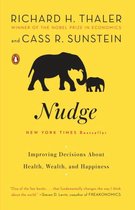
Nudge Influencing behavior
Lecture 1 introduction
Overview of the course
First set of the course (Nudge)
• Influence through cognitive heuristics
• Anticipate on biases and irrational behavior
• Building on information processing
Second set of the course (Influence)
• The workings of interpersonal influence
• I.o.w. focus on social, instead of cognitive, heuristics
• Help us to make quick, efficient choices and decisions in relation to people around us
Part A: Nudge is about choice architecture, pitfalls of intuition/overconfidence,
intertemporal choice, ethics, goal setting and nudges in health and government.
Part B: Social influence is about persuasion tactics (Cialdini), norms and normative behavior,
social conformity and pro-social behavior and sustainability.
Many types of applications will be discussed
• Increasing savings rates
• Increasing organ donation rates
• Improving road safety
• Increasing volunteering
• Getting out to vote
• Increasing exercise rates
• Increasing charitable giving
• Complying to new covid rules
Introduction to nudging
Nobel prize in economics 2017: Richard Thaler
He admitted he hadn’t persuaded all his colleagues and fellow economists of the importance
of behavioral economics, so instead, “I’ve used the strategy of corrupting the youth, whose
minds aren’t already made up,” he said. “Many great, young economists have embraced
behavioral economics...The growth of the field is really due to the work of the people that
followed me.”
Everyone understands how important nudging is.
Nudge
Definition: To push against gently, especially to gain attention or give a signal (Thaler &
Sunstein, 2008).
• It is about any aspect of the “choice architecture” that alters people’s behavior in a
predictable way without forbidding options or dramatically changing economic
incentives.
, • They are not mandates. They must be cheap and easy to avoid.
• Must be transparent
Big problems, small solutions
• Holle Bolle Gijs from the Efteling is an example of a Nudge to encourage people to
throw their waste in the bin.
• Sad and happy smileys are used to nudge people to drive faster or slower in their car.
• The stairs are painted in certain ways to get people to use the stairs more often. For
example, piano tiles or arrows.
Why do we need nudges?
• We have a difficult time to save money
• We eat too unhealthily
• We find it too difficult to stick to the rules
• We don’t think about the environment enough
Traditional economics
Assumptions of the standard economic model of consumer behavior
1. People are rational
2. People act with full information
3. People have known preferences
4. People choose the best option available
Traditional economics assume that humans are “optimal” decision making machines
• Reasoning capacity is infinite.
• Incentives can solve all problems.
• Markets are perfectly efficient.
• Every act is entirely selfish.
Two systems of thinking
System 1
• Fast
• Unconscious
• Parallel
• Associative
• Low energy
• “Doer”
System 2
• Slow
• Conscious
• Serial
• Analytic
• Consumes a LOT of energy
• “Planner”
,System 1: Intuitive, fast, reactionary
System 2: Higher-level reasoning, cognitive, slower, resource dependent
• Interaction between both systems: both systems are active when we are awake.
• System 1 continuously and involuntarily generates suggestions for system 2.
• If endorsed by system 2, impressions and intuitions turn into beliefs, and impulses
into voluntary action.
• Can work well, but it can also fail:
o The automatic system is especially prone to bias, in fact it uses bias to speed
up decision making.
o The reflective system might seem superior, but it is simply too slow to handle
even a fraction of the alternatives we are faced with every day.
Which system is used?
• If people only decided based on their reflective, rational System 2, we wouldn’t need
nudging because people would simply consider what is best (utility, preferences) in
each moment.
• However, humans often decide with their intuitive fast System 1
• Especially when we are:
o Rushed
o Tired
o Not paying attention
If it is difficult to change behavior in a rational way, how can we then guide people’s
behavior?
Nudging principles
Nudging is a combination of two believes: Libertarian paternalism
Liberalism: Thomas Paine
• The state should have respect for all citizens as free and equal human beings.
• The state should enable all citizens to develop and pursue their own conception of
the good life.
• Harm to others is only basis for legitimate government intervention.
Paternalism: Greg Johnson
• Paternalism goes further than the minimalist ‘no harm’ principle of liberalism and
argues that people should also be protected against harming themselves.
• The state should promote the interests of all citizens in living secure, healthy,
wealthy and happy lives.
• The state should interfere with people’s liberties if this generates desirable
outcomes.
, Libertarian paternalism
Libertarian paternalism or ‘nudging’ aims to improve people’s choices by being both:
• Libertarian: it does not block people’s choices and thus respects people’s (‘negative’
or ‘formal’) liberty.
• Paternalistic: it makes people better off and thus improves their well-being (health,
wealth, and happiness).
Getting people to behave differently
• It does not mean we should not use incentives, prohibition and informing people.
• But: we should also use subconscious nudges, peer-to-peer persuasion, and social
marketing among other things.
The principles of nudge
• Psychological ways of changing behavior.
• Focus on “guiding” behavior; A nudge is a guide to the wanted behavior.
• Instead of using incentives and information, use cues, frames, defaults; you can
choose yourself if you want to do what the nudge says (opt-in vs. opt-out).
• No force or prohibition! Preserve freedom of choice.
• Minimal costs
• Change of choice architecture: encourage people to select a preferred choice.
• Must be transparent.
Choice architecture
• A choice architect designs the choice environment to encourage the chooser to
select a preferred choice: the fruit is closer than the unhealthy snack.
• Maintain the chooser’s freedom to select other choices.
• Make desirable choice available, and EASIER.
• Make undesirable choice available, and HARDER.
Everyone is a choice architect
Examples of choice architects:
• Design for voters to choose candidates
• Doctors describing alternative treatments
• Form for employees to enroll in health plan
• Parent to give options to child for different education
• Salespersons are all the time choice architects.
There is no such thing as a nudge-less choice. Every design pushes people to a certain
direction.
When are nudges effective?
Behavioral economics
Assumes humans predictably deviate from “optimality”. For example:
• Heuristics: “shortcuts” that sometimes backfire.
• Overreaction to losses: people detest losing.
Lecture 1 introduction
Overview of the course
First set of the course (Nudge)
• Influence through cognitive heuristics
• Anticipate on biases and irrational behavior
• Building on information processing
Second set of the course (Influence)
• The workings of interpersonal influence
• I.o.w. focus on social, instead of cognitive, heuristics
• Help us to make quick, efficient choices and decisions in relation to people around us
Part A: Nudge is about choice architecture, pitfalls of intuition/overconfidence,
intertemporal choice, ethics, goal setting and nudges in health and government.
Part B: Social influence is about persuasion tactics (Cialdini), norms and normative behavior,
social conformity and pro-social behavior and sustainability.
Many types of applications will be discussed
• Increasing savings rates
• Increasing organ donation rates
• Improving road safety
• Increasing volunteering
• Getting out to vote
• Increasing exercise rates
• Increasing charitable giving
• Complying to new covid rules
Introduction to nudging
Nobel prize in economics 2017: Richard Thaler
He admitted he hadn’t persuaded all his colleagues and fellow economists of the importance
of behavioral economics, so instead, “I’ve used the strategy of corrupting the youth, whose
minds aren’t already made up,” he said. “Many great, young economists have embraced
behavioral economics...The growth of the field is really due to the work of the people that
followed me.”
Everyone understands how important nudging is.
Nudge
Definition: To push against gently, especially to gain attention or give a signal (Thaler &
Sunstein, 2008).
• It is about any aspect of the “choice architecture” that alters people’s behavior in a
predictable way without forbidding options or dramatically changing economic
incentives.
, • They are not mandates. They must be cheap and easy to avoid.
• Must be transparent
Big problems, small solutions
• Holle Bolle Gijs from the Efteling is an example of a Nudge to encourage people to
throw their waste in the bin.
• Sad and happy smileys are used to nudge people to drive faster or slower in their car.
• The stairs are painted in certain ways to get people to use the stairs more often. For
example, piano tiles or arrows.
Why do we need nudges?
• We have a difficult time to save money
• We eat too unhealthily
• We find it too difficult to stick to the rules
• We don’t think about the environment enough
Traditional economics
Assumptions of the standard economic model of consumer behavior
1. People are rational
2. People act with full information
3. People have known preferences
4. People choose the best option available
Traditional economics assume that humans are “optimal” decision making machines
• Reasoning capacity is infinite.
• Incentives can solve all problems.
• Markets are perfectly efficient.
• Every act is entirely selfish.
Two systems of thinking
System 1
• Fast
• Unconscious
• Parallel
• Associative
• Low energy
• “Doer”
System 2
• Slow
• Conscious
• Serial
• Analytic
• Consumes a LOT of energy
• “Planner”
,System 1: Intuitive, fast, reactionary
System 2: Higher-level reasoning, cognitive, slower, resource dependent
• Interaction between both systems: both systems are active when we are awake.
• System 1 continuously and involuntarily generates suggestions for system 2.
• If endorsed by system 2, impressions and intuitions turn into beliefs, and impulses
into voluntary action.
• Can work well, but it can also fail:
o The automatic system is especially prone to bias, in fact it uses bias to speed
up decision making.
o The reflective system might seem superior, but it is simply too slow to handle
even a fraction of the alternatives we are faced with every day.
Which system is used?
• If people only decided based on their reflective, rational System 2, we wouldn’t need
nudging because people would simply consider what is best (utility, preferences) in
each moment.
• However, humans often decide with their intuitive fast System 1
• Especially when we are:
o Rushed
o Tired
o Not paying attention
If it is difficult to change behavior in a rational way, how can we then guide people’s
behavior?
Nudging principles
Nudging is a combination of two believes: Libertarian paternalism
Liberalism: Thomas Paine
• The state should have respect for all citizens as free and equal human beings.
• The state should enable all citizens to develop and pursue their own conception of
the good life.
• Harm to others is only basis for legitimate government intervention.
Paternalism: Greg Johnson
• Paternalism goes further than the minimalist ‘no harm’ principle of liberalism and
argues that people should also be protected against harming themselves.
• The state should promote the interests of all citizens in living secure, healthy,
wealthy and happy lives.
• The state should interfere with people’s liberties if this generates desirable
outcomes.
, Libertarian paternalism
Libertarian paternalism or ‘nudging’ aims to improve people’s choices by being both:
• Libertarian: it does not block people’s choices and thus respects people’s (‘negative’
or ‘formal’) liberty.
• Paternalistic: it makes people better off and thus improves their well-being (health,
wealth, and happiness).
Getting people to behave differently
• It does not mean we should not use incentives, prohibition and informing people.
• But: we should also use subconscious nudges, peer-to-peer persuasion, and social
marketing among other things.
The principles of nudge
• Psychological ways of changing behavior.
• Focus on “guiding” behavior; A nudge is a guide to the wanted behavior.
• Instead of using incentives and information, use cues, frames, defaults; you can
choose yourself if you want to do what the nudge says (opt-in vs. opt-out).
• No force or prohibition! Preserve freedom of choice.
• Minimal costs
• Change of choice architecture: encourage people to select a preferred choice.
• Must be transparent.
Choice architecture
• A choice architect designs the choice environment to encourage the chooser to
select a preferred choice: the fruit is closer than the unhealthy snack.
• Maintain the chooser’s freedom to select other choices.
• Make desirable choice available, and EASIER.
• Make undesirable choice available, and HARDER.
Everyone is a choice architect
Examples of choice architects:
• Design for voters to choose candidates
• Doctors describing alternative treatments
• Form for employees to enroll in health plan
• Parent to give options to child for different education
• Salespersons are all the time choice architects.
There is no such thing as a nudge-less choice. Every design pushes people to a certain
direction.
When are nudges effective?
Behavioral economics
Assumes humans predictably deviate from “optimality”. For example:
• Heuristics: “shortcuts” that sometimes backfire.
• Overreaction to losses: people detest losing.