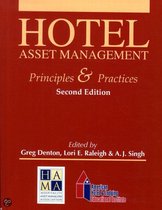
Book Hotel Asset Management Summary
Chapter 1
Professionalization: the process by which a profession arises from a trade or occupation
The Hospitality Asset Managers Association (HAMA) was formed in 1991 with the objective
of creating a unified voice for hotel owners frustrated with management companies and
contracts that heavily favored the operator.
Most asset managers had their first jobs in hotel general management (56%), while 18%
started in consulting and 16% started in accounting careers.
Firms most influential in launching asset management careers were private equity, private
investment groups, real estate investment trusts, advisory firms and hotel ownership and
development companies.
Most asset managers had their training in hotel operations (31%) or an asset management
firm (25%).
MAI: Member of Appraisal Institute (for real estate valuation professionals)
CPA: Certified Public Accountant (for auditors)
CHAE: Certified Hospitality Accountant Executive (for hotel controllers)
CFA: Certified Financial Analyst (for financial analysts)
The Certified Hotel Asset Manager (CHAM) designation is the world’s only advanced
certification available to accomplished hotel asset management professionals. Requirements:
• Two letters of recommendation
• Seven years of lead hotel asset management experience
• 200 multiple-choice questions
Functions/ activities of Hotel Asset Managers (1 most time spend on & 10 least time spend
on):
1. Monitor the financial performance
2. Capital expenditures
3. Revenue management
4. Operational reviews
5. Advise ownership on investment strategies and management issues
6. Contracts
7. Monitor investment community
8. Loan compliance
9. Franchise affiliations
A profile of the hotel asset manager is that of a highly qualified and experienced executive
with a wide range of operational, financial, and investment management skills. However, the
growing complexity and scale of the hotel business require that they periodically tap into
outside expertise to assist with their asset monitoring and management activities.
,External expertise:
- Service standards
- Revenue management
- Information technology
- Labor management
- Purchasing
- Food and beverage cost reduction
- Property taxes
- Green operations and development
- Legal issues
- Risk management
Skills important for asset manager performance:
- Investment skills: understanding market investment cycles, supply demand and
competitive analysis, ability to model discounted cash flow analyses, valuations and
hold/ sale analyses
- Financial skills: reading and analyzing financial statements, capital expenditure
analysis, forecasting and budgeting
- Soft skills: negotiating skills, analytical skills, judgement, interpersonal relations,
critical thinking, persuasion and empathy
- Planning skills: revenue management, strategic planning, market positioning
forecasting and budgeting
- People management skills: leadership, communication and motivation, teamwork,
basic understanding for technical skills
,
Chapter 1
Professionalization: the process by which a profession arises from a trade or occupation
The Hospitality Asset Managers Association (HAMA) was formed in 1991 with the objective
of creating a unified voice for hotel owners frustrated with management companies and
contracts that heavily favored the operator.
Most asset managers had their first jobs in hotel general management (56%), while 18%
started in consulting and 16% started in accounting careers.
Firms most influential in launching asset management careers were private equity, private
investment groups, real estate investment trusts, advisory firms and hotel ownership and
development companies.
Most asset managers had their training in hotel operations (31%) or an asset management
firm (25%).
MAI: Member of Appraisal Institute (for real estate valuation professionals)
CPA: Certified Public Accountant (for auditors)
CHAE: Certified Hospitality Accountant Executive (for hotel controllers)
CFA: Certified Financial Analyst (for financial analysts)
The Certified Hotel Asset Manager (CHAM) designation is the world’s only advanced
certification available to accomplished hotel asset management professionals. Requirements:
• Two letters of recommendation
• Seven years of lead hotel asset management experience
• 200 multiple-choice questions
Functions/ activities of Hotel Asset Managers (1 most time spend on & 10 least time spend
on):
1. Monitor the financial performance
2. Capital expenditures
3. Revenue management
4. Operational reviews
5. Advise ownership on investment strategies and management issues
6. Contracts
7. Monitor investment community
8. Loan compliance
9. Franchise affiliations
A profile of the hotel asset manager is that of a highly qualified and experienced executive
with a wide range of operational, financial, and investment management skills. However, the
growing complexity and scale of the hotel business require that they periodically tap into
outside expertise to assist with their asset monitoring and management activities.
,External expertise:
- Service standards
- Revenue management
- Information technology
- Labor management
- Purchasing
- Food and beverage cost reduction
- Property taxes
- Green operations and development
- Legal issues
- Risk management
Skills important for asset manager performance:
- Investment skills: understanding market investment cycles, supply demand and
competitive analysis, ability to model discounted cash flow analyses, valuations and
hold/ sale analyses
- Financial skills: reading and analyzing financial statements, capital expenditure
analysis, forecasting and budgeting
- Soft skills: negotiating skills, analytical skills, judgement, interpersonal relations,
critical thinking, persuasion and empathy
- Planning skills: revenue management, strategic planning, market positioning
forecasting and budgeting
- People management skills: leadership, communication and motivation, teamwork,
basic understanding for technical skills
,