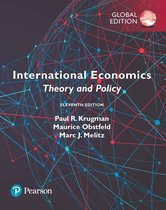
Summary International Economics
Chapter 1: introduction
What is international economics about?
The motives and behavior of individuals are the same in international trade as they are in domestic
transactions.
Seven themes recur throughout the study of international economics: (1) the gain from trade, (2) the pattern
of trade, (3) protectionism, (4) the balance of payments, (5) exchange rate determination, (6) international
policy coordination, and (7) the international capital market.
The gain from trade
When countries sell goods and services to each other, this exchange is almost always to their mutual benefit.
Two countries can trade to their mutual benefit even when one of them is more efficient that the other at
producing everything and when producers in the less-efficient country can compete only by paying lower
wages.
International trade allows countries to specialize in producing narrower ranges of goods, giving them greater
efficiencies of large-scale production.
International trade can adversely affect the owners of resources that are “specific” to industries that compete
with imports, that is, cannot find alternative employment in other industries.
The pattern of trade
Economists cannot discuss the effects of international trade or recommend the changes in government policies
toward trade with any confidence unless they know their theory is good enough to explain the international
trade that is actually observed. As a result, attempts to explain the pattern of international trade – who sells
what to whom – have been a major preoccupation of international economists.
How much trade?
The single most consistent mission of international economics has been to analyze the effects of these so-
called protectionist policies – and usually, though not always, to criticize protectionism and show the
advantages of freer international trade.
The relative power of different interest groups within countries, rather than some measure of overall national
interest, is often the main determining factors in government policies toward international trade.
Balance of payments
A country’s balance of payments must be placed in the context of an economic analysis to understand what is
means. it emerges in a variety of specific contexts: in discussing foreign direct investment by multinational
corporations, in relating international transactions to national income accounting, and in discussing virtually
every aspect of international monetary policy.
Exchange rate determination
A key difference between international economics and other areas of economics is that countries usually have
their own currencies. The real value of this currencies can change over time, sometimes drastically.
International policy coordination
Differences in goals among countries often lead to conflicts of interest. Even when countries have similar goals,
they may suffer losses if they fail to coordinate their policies.
,A fundamental problem in international economics if determining how to produce an acceptable degree of
harmony among the international trade and monetary policies of different countries in the absence of a world
government that tells countries what to do.
The international capital market
In any sophisticated economy, there is an extensive capital market: a set of arrangements by which individuals
and firms exchange money now for promises to pay in the future.
The international capital market links the capital markets of individual countries.
International capital markets differ in important ways from domestic capital markets. They must cope with
special regulations that many countries impose on foreign investment; they also sometimes offer opportunities
to evade regulations placed on domestic markets.
Some special risks are associated with international capital markets:
1. Currency fluctuations; if the euro falls against the dollar, US investors who bought euro bonds suffer a
capital loss.
2. National default; a nation may simply refuse to pay its debts (perhaps because it cannot), and there
may be no effective way for its creditors to bring it to court.
International economics: trade and money
The economics of the international economy can be divided into two broad subfields:
1. International trade; focuses primarily on the real transactions in the international economy, that is,
transaction involving a physical movement of goods or a tangible commitment of economic resources.
2. International money.
International monetary analysis focuses on the monetary side of the international economy, that is, on
financial transactions such as foreign purchases of US dollars.
Most international trade involves monetary transactions, while many monetary events have important
consequences for trade. Nonetheless, the distinction between international trade and international money is
useful.
,Chapter 13: national income accounting and the balance of payments
Microeconomics works “from the bottom up” to show how individual economic actors, by pursuing their own
interests, collectively determine how resources are used.
Macroeconomic is the branch of economics that studies how economies’ overall level of employment,
production, and growth are determined.
Macroeconomic analysis emphasized four aspects of economic life:
1. Unemployment. Macroeconomics studies the factors that cause unemployment and the steps
government can take to prevent it.
2. Saving. A country’s savings or borrowing behaving affects domestic employment and future levels of
national wealth.
3. Trade imbalances. Trade imbalances redistribute wealth among countries and are a main channel
through which one country’s macroeconomic policies affect its trading partners.
4. Money and the price level. Stability in money price levels is an important goal of international
macroeconomic policy.
National income accounting records all the expenditures that contribute to a country’s income and output.
Balance of payments accounting helps us keep track of both changes in a country’s indebtedness to foreigners
and the fortunes of its export- and import-competing industries. The balance of payments accounts also show
the connection between foreign transactions and national money supplies.
The national income accounts
Gross national product (GNP) is the value of all final goods and services produced by the country’s factors of
production and sold on the market in a given time period.
GNP, which is the basic measure of a country’s output studied by macroeconomists, is calculated by adding up
the market value of all expenditures on final output.
GNP is divided among four possible uses for which a country’s final output is purchased: consumption (the
amount consumed by private domestic residents), investment (the amount put aside by private firms to build
new plant and equipment for future production), government purchases (the amount used by the
government), and the current account balance (the amount of net exports of goods and services to foreigners).
The term national income accounts, rather than national output accounts, is used to describe this fourfold
classification because a country’s income in fact equals its output.
National product and national income
National income is the income earned in that period by the country’s factors of production.
It is to avoid such double counting that we allow only the sale of final goods and services to enter into the
definition of GNP. The definition counts only final goods and services that are produced. So, the sale of a used
textbook does not generate income for any factors of production and does not qualify.
Capital depreciation and international transfers
Two adjustments to the definition of GNP must be made, however, before the identification of GNP and
national income is entirely correct in practice.
1. GNP does not take into account the economic loss due to the tendency of machinery and structures to
wear out as they are used. This loss, called depreciation, reduces the income of capital owners. To
calculate national income over a given period, we must therefore subtract from GNP the depreciation
of capital over the period. GNP less depreciation is called net national product (NNP).
2. A country’s income may include gifts from residents of foreign countries, called unilateral transfers.
Net unilateral transfers are part of a country’s income but are not part of its product, and they must
be added to NNP in calculations of national income.
, National income equals GNP less depreciation plus net unilateral transfers. The difference between GNP and
national income is by no means an insignificant amount.
Gross domestic product
Gross domestic product (GDP) is supposed to sure the volume of production within a country’s borders,
whereas GNP equals GDP plus net receipts of factor income from the rest of the world.
GDP does not correct, as GNP does, for the portion of countries’ production carried out using services provided
by foreign-owned capital and labor.
National income accounting for an open economy
In open economies, saving and investment are not necessarily equal, as they are in a closed economy. This
occurs because countries can save in the form of foreign wealth by exporting more than they import, and they
can dissave – that is, reduce their foreign wealth – by exporting less than they import.
Consumption
The portion of GNP purchased by private households to fulfill current wants is called consumption.
Consumption expenditure is the largest component of GNP in most economies.
Investment
The part of output used by private firms to produce future output is called investment.
Investment spending may be viewed as the portion of GNP used to increase the nation’s stock of capital.
Firm’s purchases of inventories are also counted in investment spending because carrying inventories is just
another way for firms to transfer output from current use to future use.
We often use the word investment to describe individual households’ purchases of stocks, bonds, or real
estate, but you should be careful not to confuse this everyday meaning of the word with the economic
definition of investment as a part of GNP.
For example, when you buy a share of Microsoft stock, you are buying neither a good nor a service, so your
purchase does not show up in GNP.
Government purchases
Any goods and services purchased by federal, state, or local governments are classified as government
purchase in the national income accounts.
Government purchases include investment as well as consumption purchases.
Transfer payments are not included in government purchases.
The national income identity for an open economy
Since all of a closed economy’s output must be consumed, invested, or bought by the government, we can
write Y = C + I + G
→ Let Y stand for GNP, C for consumption, I for investment, and G for government purchases.
The GNP identity for open economies shows how the national income a country earns by selling its goods and
services is divided between sales to domestic residents and sales to foreign residents.
The national income identity for an open economy is: Y = C + I + G + EX – IM
Chapter 1: introduction
What is international economics about?
The motives and behavior of individuals are the same in international trade as they are in domestic
transactions.
Seven themes recur throughout the study of international economics: (1) the gain from trade, (2) the pattern
of trade, (3) protectionism, (4) the balance of payments, (5) exchange rate determination, (6) international
policy coordination, and (7) the international capital market.
The gain from trade
When countries sell goods and services to each other, this exchange is almost always to their mutual benefit.
Two countries can trade to their mutual benefit even when one of them is more efficient that the other at
producing everything and when producers in the less-efficient country can compete only by paying lower
wages.
International trade allows countries to specialize in producing narrower ranges of goods, giving them greater
efficiencies of large-scale production.
International trade can adversely affect the owners of resources that are “specific” to industries that compete
with imports, that is, cannot find alternative employment in other industries.
The pattern of trade
Economists cannot discuss the effects of international trade or recommend the changes in government policies
toward trade with any confidence unless they know their theory is good enough to explain the international
trade that is actually observed. As a result, attempts to explain the pattern of international trade – who sells
what to whom – have been a major preoccupation of international economists.
How much trade?
The single most consistent mission of international economics has been to analyze the effects of these so-
called protectionist policies – and usually, though not always, to criticize protectionism and show the
advantages of freer international trade.
The relative power of different interest groups within countries, rather than some measure of overall national
interest, is often the main determining factors in government policies toward international trade.
Balance of payments
A country’s balance of payments must be placed in the context of an economic analysis to understand what is
means. it emerges in a variety of specific contexts: in discussing foreign direct investment by multinational
corporations, in relating international transactions to national income accounting, and in discussing virtually
every aspect of international monetary policy.
Exchange rate determination
A key difference between international economics and other areas of economics is that countries usually have
their own currencies. The real value of this currencies can change over time, sometimes drastically.
International policy coordination
Differences in goals among countries often lead to conflicts of interest. Even when countries have similar goals,
they may suffer losses if they fail to coordinate their policies.
,A fundamental problem in international economics if determining how to produce an acceptable degree of
harmony among the international trade and monetary policies of different countries in the absence of a world
government that tells countries what to do.
The international capital market
In any sophisticated economy, there is an extensive capital market: a set of arrangements by which individuals
and firms exchange money now for promises to pay in the future.
The international capital market links the capital markets of individual countries.
International capital markets differ in important ways from domestic capital markets. They must cope with
special regulations that many countries impose on foreign investment; they also sometimes offer opportunities
to evade regulations placed on domestic markets.
Some special risks are associated with international capital markets:
1. Currency fluctuations; if the euro falls against the dollar, US investors who bought euro bonds suffer a
capital loss.
2. National default; a nation may simply refuse to pay its debts (perhaps because it cannot), and there
may be no effective way for its creditors to bring it to court.
International economics: trade and money
The economics of the international economy can be divided into two broad subfields:
1. International trade; focuses primarily on the real transactions in the international economy, that is,
transaction involving a physical movement of goods or a tangible commitment of economic resources.
2. International money.
International monetary analysis focuses on the monetary side of the international economy, that is, on
financial transactions such as foreign purchases of US dollars.
Most international trade involves monetary transactions, while many monetary events have important
consequences for trade. Nonetheless, the distinction between international trade and international money is
useful.
,Chapter 13: national income accounting and the balance of payments
Microeconomics works “from the bottom up” to show how individual economic actors, by pursuing their own
interests, collectively determine how resources are used.
Macroeconomic is the branch of economics that studies how economies’ overall level of employment,
production, and growth are determined.
Macroeconomic analysis emphasized four aspects of economic life:
1. Unemployment. Macroeconomics studies the factors that cause unemployment and the steps
government can take to prevent it.
2. Saving. A country’s savings or borrowing behaving affects domestic employment and future levels of
national wealth.
3. Trade imbalances. Trade imbalances redistribute wealth among countries and are a main channel
through which one country’s macroeconomic policies affect its trading partners.
4. Money and the price level. Stability in money price levels is an important goal of international
macroeconomic policy.
National income accounting records all the expenditures that contribute to a country’s income and output.
Balance of payments accounting helps us keep track of both changes in a country’s indebtedness to foreigners
and the fortunes of its export- and import-competing industries. The balance of payments accounts also show
the connection between foreign transactions and national money supplies.
The national income accounts
Gross national product (GNP) is the value of all final goods and services produced by the country’s factors of
production and sold on the market in a given time period.
GNP, which is the basic measure of a country’s output studied by macroeconomists, is calculated by adding up
the market value of all expenditures on final output.
GNP is divided among four possible uses for which a country’s final output is purchased: consumption (the
amount consumed by private domestic residents), investment (the amount put aside by private firms to build
new plant and equipment for future production), government purchases (the amount used by the
government), and the current account balance (the amount of net exports of goods and services to foreigners).
The term national income accounts, rather than national output accounts, is used to describe this fourfold
classification because a country’s income in fact equals its output.
National product and national income
National income is the income earned in that period by the country’s factors of production.
It is to avoid such double counting that we allow only the sale of final goods and services to enter into the
definition of GNP. The definition counts only final goods and services that are produced. So, the sale of a used
textbook does not generate income for any factors of production and does not qualify.
Capital depreciation and international transfers
Two adjustments to the definition of GNP must be made, however, before the identification of GNP and
national income is entirely correct in practice.
1. GNP does not take into account the economic loss due to the tendency of machinery and structures to
wear out as they are used. This loss, called depreciation, reduces the income of capital owners. To
calculate national income over a given period, we must therefore subtract from GNP the depreciation
of capital over the period. GNP less depreciation is called net national product (NNP).
2. A country’s income may include gifts from residents of foreign countries, called unilateral transfers.
Net unilateral transfers are part of a country’s income but are not part of its product, and they must
be added to NNP in calculations of national income.
, National income equals GNP less depreciation plus net unilateral transfers. The difference between GNP and
national income is by no means an insignificant amount.
Gross domestic product
Gross domestic product (GDP) is supposed to sure the volume of production within a country’s borders,
whereas GNP equals GDP plus net receipts of factor income from the rest of the world.
GDP does not correct, as GNP does, for the portion of countries’ production carried out using services provided
by foreign-owned capital and labor.
National income accounting for an open economy
In open economies, saving and investment are not necessarily equal, as they are in a closed economy. This
occurs because countries can save in the form of foreign wealth by exporting more than they import, and they
can dissave – that is, reduce their foreign wealth – by exporting less than they import.
Consumption
The portion of GNP purchased by private households to fulfill current wants is called consumption.
Consumption expenditure is the largest component of GNP in most economies.
Investment
The part of output used by private firms to produce future output is called investment.
Investment spending may be viewed as the portion of GNP used to increase the nation’s stock of capital.
Firm’s purchases of inventories are also counted in investment spending because carrying inventories is just
another way for firms to transfer output from current use to future use.
We often use the word investment to describe individual households’ purchases of stocks, bonds, or real
estate, but you should be careful not to confuse this everyday meaning of the word with the economic
definition of investment as a part of GNP.
For example, when you buy a share of Microsoft stock, you are buying neither a good nor a service, so your
purchase does not show up in GNP.
Government purchases
Any goods and services purchased by federal, state, or local governments are classified as government
purchase in the national income accounts.
Government purchases include investment as well as consumption purchases.
Transfer payments are not included in government purchases.
The national income identity for an open economy
Since all of a closed economy’s output must be consumed, invested, or bought by the government, we can
write Y = C + I + G
→ Let Y stand for GNP, C for consumption, I for investment, and G for government purchases.
The GNP identity for open economies shows how the national income a country earns by selling its goods and
services is divided between sales to domestic residents and sales to foreign residents.
The national income identity for an open economy is: Y = C + I + G + EX – IM