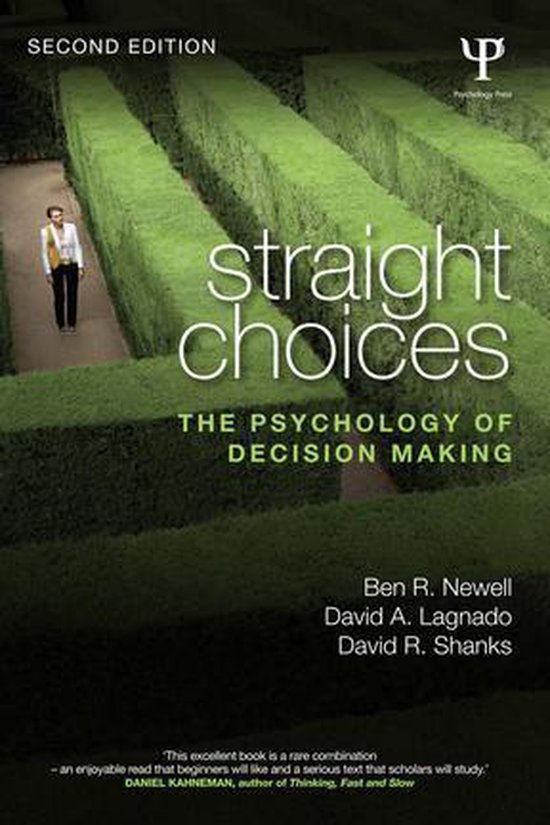
Exam Summary Decision Making in Practice
“Straight Choices” by Newell, Lagnado & Shanks (2015) – Second Edition
Chapters 1, 2, 3, 4, 5, 6, 8, 9, 11, 15, 16 and 17 + additional articles
NOT included: Chapters 7,10,12,13,14,18
Summary by: Minou van Os
Leiden University Elective Course 2020
, Summary Straight Choices – Minou van Os 2020
Introduction
This summary has been written in a complete but comprehensive style. It only includes
the chapters necessary for the 2020 ‘Decision Making in Practice’ exam (1, 2, 3, 4, 5, 6, 8,
9, 11, 15, 16 and 17) as well as the additional articles that are part of the exam. Not all
examples from the book have been included to keep the summary concise. Excluding the
introduction and content pages, this summary is 34 pages in total. The book summary is
28 pages and the remainder of 6 pages contains the articles. The most important
concepts are in bold, so you can find and revisit them easily. Names of researchers are
highlighted. Each chapter ends with a short summary column.
Without a doubt, you are very curious to read more. So what is the book about? Humans
face a perplexing array of decisions every day. Straight Choices provides an integrative
account of the psychology of decision making, and shows how psychological research
can help us understand our uncertain world. The book emphasizes the relationship
between learning and decision making. It argues that the best way to understand
how and why decisions are made, is in the context of the learning and knowledge
acquisition which precedes them, and the feedback which follows. Key topics are:
learning mechanisms, environmental structures, cognitive biases and optimal decision
strategies.
The emphasis of this book is on the practical applications of much of the research on
decision making. The authors aspire that you will gain a greater understanding of the
psychology of how – and how well – we make decisions, and that you will apply that
understanding to improve your own decision making! (that sounds great, doesn’t it?)
2
, Summary Straight Choices – Minou van Os 2020
Contents
Chapter 1: Falling Off the Straight and Narrow p. 4
Chapter 2: Decision Quality and a Historical Context p. 6
Chapter 3: Stages of Judgment I: Discovering, Acquiring and Combining Information p. 8
Chapter 4: Stages of Judgment II: Feedback Effects and Dynamic Environments p.
11
Chapter 5: Appraising Probability Judgments p.
13
Chapter 6: Judgmental Heuristics and Biases p.
15
Chapter 8: Analysing Decisions I: A General Framework p.
18
Chapter 9: Analysing Decisions II: Prospect Theory and Preference Reversals p.
20
Chapter 11: Decisions Across Time p.
23
Chapter 15: Emotional Influences on Decision Making p.
26
Chapter 16: Group Decision Making p.
28
Chapter 17: Applying Psychological Insights to the World Outside the Laboratory p.
30
Memory in the Courtroom
- Loftus, E.F. (2005). Planting Misinformation in the Human Mind p. 32
- Benton, T.R., et al. (2006). Eyewitness Memory is Still Not Common Sense p. 33
- Kassin, S.M.(2005). On the Psychology of Confessions p. 34
Decision Making in Healthcare
- Stiggelbout, A. M., Pieterse, A. H., & De Haes, J. C. J. M. (2015). Shared Decision p. 35
Making: Concepts, Evidence, and Practice
- Singh, B., Hawthorne, G., & Vos, T. (2001). The Role of Economic Evaluation in p. 36
Mental Health Care
3
, Summary Straight Choices – Minou van Os 2020
Chapter 1: Falling Off the Straight and Narrow
If you had to guess, which do you think is more likely: getting killed
by falling aeroplane parts falling from the sky, or by a shark attack?
The majority of people picks the shark attack. But actually we are
30 times more likely to be killed by falling aeroplane parts! This
mistake is caused by the availability heuristic, or ease of recall.
Shark attacks are easier to recall, presumably due to wider media
coverage, which makes most people think they are more likely to
happen.
Most well-documented errors or biases of judgment occur in one-shot decision situations like
the previous example. We do not have the chance to learn adequately about the environment.
The heuristics and biases approach (Kahneman, Slovic & Tversky) applies to these kinds of
errors. However: this is a pessimistic view of human judgment and decision making. Actually,
when we are given the opportunity to learn about information in the environment through
repetition and feedback, our judgments and decisions are exceptionally accurate. But in some
cases, these heuristics and biases are present. Some examples:
1. Which medical treatment should I choose?
Martin and Simon have both been diagnosed with lung cancer. They have to choose
between radiation and surgery. Each of them receives different information:
1) Simon: “Of 100 people having surgery, on average, 10 will die during
treatment, 32 will have died by one year and 66 will have died by five years. Of
100 people having radiation therapy, on average, none will die during treatment, 23 will
die by one year and 78 will die by five years” (mortality frame)
2) Martin: “Of 100 people having surgery, on average, 90 will survive the treatment, 68 will
survive for one year and 34 will survive for five years. Of 100 people having radiation
therapy, on average, all will survive the treatment, 77 will survive for one year and 22
will survive for five years” (survival frame)
Simon will be most likely to opt for surgery and Martin for radiation therapy due to the framing
of the information. The risk of dying during treatment looms larger when it is presented in terms
of mortality than in terms of survival. This was an example of positive versus negative
framing. Another example of framing is information about relative and absolute risks:
Savastatin is proven to reduce the risk of coronary mortality by 3.5%
Savastatin is proven to reduce the risk of coronary mortality by 42%
The second statement makes it sound like Savastatin is a much better drug. However, both
statements are actually different risk estimates considering the same drug. The percentage in
4
“Straight Choices” by Newell, Lagnado & Shanks (2015) – Second Edition
Chapters 1, 2, 3, 4, 5, 6, 8, 9, 11, 15, 16 and 17 + additional articles
NOT included: Chapters 7,10,12,13,14,18
Summary by: Minou van Os
Leiden University Elective Course 2020
, Summary Straight Choices – Minou van Os 2020
Introduction
This summary has been written in a complete but comprehensive style. It only includes
the chapters necessary for the 2020 ‘Decision Making in Practice’ exam (1, 2, 3, 4, 5, 6, 8,
9, 11, 15, 16 and 17) as well as the additional articles that are part of the exam. Not all
examples from the book have been included to keep the summary concise. Excluding the
introduction and content pages, this summary is 34 pages in total. The book summary is
28 pages and the remainder of 6 pages contains the articles. The most important
concepts are in bold, so you can find and revisit them easily. Names of researchers are
highlighted. Each chapter ends with a short summary column.
Without a doubt, you are very curious to read more. So what is the book about? Humans
face a perplexing array of decisions every day. Straight Choices provides an integrative
account of the psychology of decision making, and shows how psychological research
can help us understand our uncertain world. The book emphasizes the relationship
between learning and decision making. It argues that the best way to understand
how and why decisions are made, is in the context of the learning and knowledge
acquisition which precedes them, and the feedback which follows. Key topics are:
learning mechanisms, environmental structures, cognitive biases and optimal decision
strategies.
The emphasis of this book is on the practical applications of much of the research on
decision making. The authors aspire that you will gain a greater understanding of the
psychology of how – and how well – we make decisions, and that you will apply that
understanding to improve your own decision making! (that sounds great, doesn’t it?)
2
, Summary Straight Choices – Minou van Os 2020
Contents
Chapter 1: Falling Off the Straight and Narrow p. 4
Chapter 2: Decision Quality and a Historical Context p. 6
Chapter 3: Stages of Judgment I: Discovering, Acquiring and Combining Information p. 8
Chapter 4: Stages of Judgment II: Feedback Effects and Dynamic Environments p.
11
Chapter 5: Appraising Probability Judgments p.
13
Chapter 6: Judgmental Heuristics and Biases p.
15
Chapter 8: Analysing Decisions I: A General Framework p.
18
Chapter 9: Analysing Decisions II: Prospect Theory and Preference Reversals p.
20
Chapter 11: Decisions Across Time p.
23
Chapter 15: Emotional Influences on Decision Making p.
26
Chapter 16: Group Decision Making p.
28
Chapter 17: Applying Psychological Insights to the World Outside the Laboratory p.
30
Memory in the Courtroom
- Loftus, E.F. (2005). Planting Misinformation in the Human Mind p. 32
- Benton, T.R., et al. (2006). Eyewitness Memory is Still Not Common Sense p. 33
- Kassin, S.M.(2005). On the Psychology of Confessions p. 34
Decision Making in Healthcare
- Stiggelbout, A. M., Pieterse, A. H., & De Haes, J. C. J. M. (2015). Shared Decision p. 35
Making: Concepts, Evidence, and Practice
- Singh, B., Hawthorne, G., & Vos, T. (2001). The Role of Economic Evaluation in p. 36
Mental Health Care
3
, Summary Straight Choices – Minou van Os 2020
Chapter 1: Falling Off the Straight and Narrow
If you had to guess, which do you think is more likely: getting killed
by falling aeroplane parts falling from the sky, or by a shark attack?
The majority of people picks the shark attack. But actually we are
30 times more likely to be killed by falling aeroplane parts! This
mistake is caused by the availability heuristic, or ease of recall.
Shark attacks are easier to recall, presumably due to wider media
coverage, which makes most people think they are more likely to
happen.
Most well-documented errors or biases of judgment occur in one-shot decision situations like
the previous example. We do not have the chance to learn adequately about the environment.
The heuristics and biases approach (Kahneman, Slovic & Tversky) applies to these kinds of
errors. However: this is a pessimistic view of human judgment and decision making. Actually,
when we are given the opportunity to learn about information in the environment through
repetition and feedback, our judgments and decisions are exceptionally accurate. But in some
cases, these heuristics and biases are present. Some examples:
1. Which medical treatment should I choose?
Martin and Simon have both been diagnosed with lung cancer. They have to choose
between radiation and surgery. Each of them receives different information:
1) Simon: “Of 100 people having surgery, on average, 10 will die during
treatment, 32 will have died by one year and 66 will have died by five years. Of
100 people having radiation therapy, on average, none will die during treatment, 23 will
die by one year and 78 will die by five years” (mortality frame)
2) Martin: “Of 100 people having surgery, on average, 90 will survive the treatment, 68 will
survive for one year and 34 will survive for five years. Of 100 people having radiation
therapy, on average, all will survive the treatment, 77 will survive for one year and 22
will survive for five years” (survival frame)
Simon will be most likely to opt for surgery and Martin for radiation therapy due to the framing
of the information. The risk of dying during treatment looms larger when it is presented in terms
of mortality than in terms of survival. This was an example of positive versus negative
framing. Another example of framing is information about relative and absolute risks:
Savastatin is proven to reduce the risk of coronary mortality by 3.5%
Savastatin is proven to reduce the risk of coronary mortality by 42%
The second statement makes it sound like Savastatin is a much better drug. However, both
statements are actually different risk estimates considering the same drug. The percentage in
4