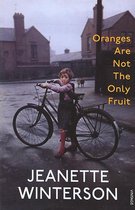
Oranges Are Not The Only Fruit
Jeanette Winterson
For Gill Saunders and Fang the Cat
`When thick rinds are used the top must be thoroughly skimmed, or a scum will form
marring the final appearence.'
—From The Making of Marmalade by Mrs Beeton
`Oranges are not the only fruit'
—Nell Gwynn
Genesis
Like most people I lived for a long time with my mother and father. My father liked to watch the
wrestling, my mother liked to wrestle; it didn't matter what. She was in the white corner and that was
that.
She hung out the largest sheets on the windiest days. She wanted the Mormons to knock on the door. At
election time in a Labour mill town she put a picture of the Conservative candidate in the window.
She had never heard of mixed feelings. There were friends and there were enemies.
Enemies were:
● The Devil (in his many forms)
● Next Door
● Sex (in its many forms)
● Slugs
Friends were:
● God
● Our dog
● Auntie Madge
● The Novels of Charlotte Brontë
● Slug pellets
,and me, at first. I had been brought in to join her in a tag match against the Rest of the World. She had a
mysterious attitude towards the begetting of children; it wasn't that she couldn't do it, more that she
didn't want to do it. She was very bitter about the Virgin Mary getting there first. So she did the next
best thing and arranged for a foundling. That was me.
I cannot recall a time when I did not know that I was special. We had no Wise Men because she didn't
believe there were any wise men, but we had sheep. One of my earliest memories is me sitting on a
sheep at Easter while she told me the story of the Sacrificial Lamb. We had it on Sundays with potato.
Sunday was the Lord's day, the most vigorous day of the whole week; we had a radiogram at home with
an imposing mahogany front and a fat Bakelite knob to twiddle for the stations. Usually we listened to
the Light Programme, but on Sundays always the World Service, so that my mother could record the
progress of our missionaries. Our Missionary Map was very fine. On the front were all the countries and
on the back a number chart that told you about Tribes and their Peculiarities. My favourite was Number
16, The Buzule of Carpathian. They believed that if a mouse found your hair clippings and built a nest
with them you got a headache. If the nest was big enough, you might go mad. As far as I knew no
missionary had yet visited them.
My mother got up early on Sundays and allowed no one into the parlour until ten o'clock. It was her
place of prayer and meditation. She always prayed standing up, because of her knees, just as Bonaparte
always gave orders from his horse, because of his size. I do think that the relationship my mother
enjoyed with God had a lot to do with positioning. She was Old Testament through and through. Not for
her the meek and paschal Lamb, she was out there, up front with the prophets, and much given to
sulking under trees when the appropriate destruction didn't materialise. Quite often it did, her will or the
Lord's I can't say.
She always prayed in exactly the same way. First of all she thanked God that she had lived to see
another day, and then she thanked God for sparing the world another day. Then she spoke of her
enemies, which was the nearest thing to she had to a catechism.
As soon as `Vengeance is mine saith the Lord' boomed through the wall into the kitchen, I put the kettle
on. The time it took to boil the water and brew the tea was just about the length of her final item, the sick
list. She was very regular. I put the milk in, in she came, and taking a great gulp of tea said one of three
things.
`The Lord is good' (steely-eyed into the back yard).
`What sort of tea is this?' (steely-eyed at me).
`Who was the oldest man in the Bible?'
No. 3, of course, had a number of variations, but it was always a Bible quiz question. We had a lot of
,Bible quizzes at church and my mother liked me to win. If I knew the answer she asked me another, if I
didn't she got cross, but luckily not for long, because we had to listen to the World Service. It was
always the same; we sat down on either side of the radiogram, she with her tea, me with a pad and
pencil; in front of us, the Missionary Map. The faraway voice in the middle of the set gave news of
activities, converts and problems. At the end there was an appeal for YOUR PRAYERS. I had to write it
all down so that my mother could deliver her church report that night. She was the Missionary Secretary.
The Missionary Report was a great trial to me because our mid-day meal depended upon it. If it went
well, no deaths and lots of converts, my mother cooked a joint. If the Godless had proved not only
stubborn, but murderous, my mother spent the rest of the morning listening to the Jim Reeves
Devotional Selection, and we had to have boiled eggs and toast soldiers. Her husband was an easy-going
man, but I knew it depressed him. He would have cooked it himself but for my mother's complete
conviction that she was the only person in our house who could tell a saucepan from a piano. She was
wrong, as far as we were concerned, but right as far as she was concerned, and really, that's what
mattered.
Somehow we got through those mornings, and in the afternoon she and I took the dog for a walk, while
my father cleaned all the shoes. `You can tell someone by their shoes,' my mother said. `Look at Next
Door.'
`Drink,' said my mother grimly as we stepped out past their house. `That's why they buy everything from
Maxi Ball's Catalogue Seconds. The Devil himself is a drunk' (sometimes my mother invented theology)
Maxi Ball owned a warehouse, his clothes were cheap but they didn't last, and they smelt of industrial
glue. The desperate, the careless, the poorest, vied with one another on a Saturday morning to pick up
what they could, and haggle over the price. My mother would rather not eat than be seen at Maxi Ball's.
She had filled me with a horror of the place. Since so many people we knew went there, it was hardly
fair of her but she never was particularly fair; she loved and she hated, and she hated Maxi Ball. Once, in
winter, she had been forced to go there to buy a corset and in the middle of communion, that very
Sunday, a piece of whalebone slipped out and stabbed her right in the stomach. There was nothing she
could do for an hour. When we got home she tore up the corset and used the whalebone as supports for
our geraniums, except for one piece that she gave to me. I still have it, and whenever I'm tempted to cut
corners I think about that whalebone, and I know better.
My mother and I walked on towards the hill that stood at the top of our street. We lived in a town stolen
from the valleys, a huddled place full of chimneys and little shops and back-to-back houses with no
gardens. The hills surrounded us, and our own swept out into the Pennines, broken now and again with a
farm or a relic from the war. There used to be a lot of old tanks but the council took them away. The
town was a fat blot and the streets spread back from it into the green, steadily upwards. Our house was
almost at the top of a long, stretchy street. A flagged street with a cobbly road. When you climb to the
top of the hill and look down you can see everything, just like Jesus on the pinnacle except it's not very
tempting. Over to the right was the viaduct and behind the viaduct Ellison's tenement, where we had the
fair once a year. I was allowed to go there on condition I brought back a tub of black peas for my
mother. Black peas look like rabbit droppings and they come in a thin gravy made of stock and gypsy
, mush. They taste wonderful. The gypsies made a mess and stayed up all night and my mother called
them fornicators but on the whole we got on very well. They turned a blind eye to toffee apples going
missing, and sometimes, if it was quiet and you didn't have enough money, they still let you have a ride
on the dodgems. We used to have fights round the caravans, the ones like me, from the street, against the
posh ones from the Avenue. The posh ones went to Brownies and didn't stay for school dinners.
Once, when I was collecting the black peas, about to go home, the old woman got hold of my hand. I
thought she was going to bite me. She looked at my palm and laughed a bit. `You'll never marry,' she
said, `not you, and you'll never be still.' She didn't take any money for the peas, and she told me to run
home fast. I ran and ran, trying to understand what she meant. I hadn't thought about getting married
anyway. There were two women I knew who didn't have husbands at all; they were old though, as old as
my mother. They ran the paper shop and sometimes, on a Wednesday, they gave me a banana bar with
my comic. I liked them a lot, and talked about them a lot to my mother. One day they asked me if I'd like
to go to the seaside with them. I ran home, gabbled it out, and was busy emptying my money box to buy
a new spade, when my mother said firmly and forever, no. I couldn't understand why not, and she
wouldn't explain. She didn't even let me go back to say I couldn't. Then she cancelled my comic and told
me to collect it from another shop, further away. I was sorry about that. I never got a banana bar from
Grimsby's. A couple of weeks later I heard her telling Mrs White about it. She said they dealt in
unnatural passions. I thought she meant they put chemicals in their sweets.
My mother and I climbed and climbed until the town fell away and we reached the memorial stone at the
very top. The wind was always strong so that my mother had to wear extra hat pins. Usually she wore a
headscarf, but not on Sunday. We sat on the stone's base and she thanked the Lord we had managed the
ascent. Then she extemporised on the nature of the world, the folly of its peoples, and the wrath of God
inevitable. After that she told me a story about a brave person who had despised the fruits of the flesh
and worked for the Lord instead….
There was the story of the `converted sweep', a filthy degenerate, given to drunkenness and vice, who
suddenly found the Lord whilst scraping the insides of a flue. He remained in the flue in a state of
rapture for so long that his friends thought he was unconscious. After a great deal of difficulty they
persuaded him to come out; his face, they declared, though hardly visible for the grime, shone like an
angel's. He started to lead the Sunday School and died some time later, bound for glory. There were
many more; I particularly like the `Hallelujah Giant', a freak of nature, eight feet tall shrunk to six foot
three through the prayers of the faithful.
Now and again my mother liked to tell me her own conversion story; it was very romantic. I sometimes
think that if Mills and Boon were at all revivalist in their policy my mother would be a star.
One night, by mistake, she had walked into Pastor Spratt's Glory Crusade. It was in a tent on some spare
land, and every evening Pastor Spratt spoke of the fate of the damned, and performed healing miracles.
He was very impressive. My mother said he looked like Errol Flynn, but holy. A lot of women found the
Lord that week. Part of Pastor Spratt's charisma stemmed from his time spent as an advertising manager
Jeanette Winterson
For Gill Saunders and Fang the Cat
`When thick rinds are used the top must be thoroughly skimmed, or a scum will form
marring the final appearence.'
—From The Making of Marmalade by Mrs Beeton
`Oranges are not the only fruit'
—Nell Gwynn
Genesis
Like most people I lived for a long time with my mother and father. My father liked to watch the
wrestling, my mother liked to wrestle; it didn't matter what. She was in the white corner and that was
that.
She hung out the largest sheets on the windiest days. She wanted the Mormons to knock on the door. At
election time in a Labour mill town she put a picture of the Conservative candidate in the window.
She had never heard of mixed feelings. There were friends and there were enemies.
Enemies were:
● The Devil (in his many forms)
● Next Door
● Sex (in its many forms)
● Slugs
Friends were:
● God
● Our dog
● Auntie Madge
● The Novels of Charlotte Brontë
● Slug pellets
,and me, at first. I had been brought in to join her in a tag match against the Rest of the World. She had a
mysterious attitude towards the begetting of children; it wasn't that she couldn't do it, more that she
didn't want to do it. She was very bitter about the Virgin Mary getting there first. So she did the next
best thing and arranged for a foundling. That was me.
I cannot recall a time when I did not know that I was special. We had no Wise Men because she didn't
believe there were any wise men, but we had sheep. One of my earliest memories is me sitting on a
sheep at Easter while she told me the story of the Sacrificial Lamb. We had it on Sundays with potato.
Sunday was the Lord's day, the most vigorous day of the whole week; we had a radiogram at home with
an imposing mahogany front and a fat Bakelite knob to twiddle for the stations. Usually we listened to
the Light Programme, but on Sundays always the World Service, so that my mother could record the
progress of our missionaries. Our Missionary Map was very fine. On the front were all the countries and
on the back a number chart that told you about Tribes and their Peculiarities. My favourite was Number
16, The Buzule of Carpathian. They believed that if a mouse found your hair clippings and built a nest
with them you got a headache. If the nest was big enough, you might go mad. As far as I knew no
missionary had yet visited them.
My mother got up early on Sundays and allowed no one into the parlour until ten o'clock. It was her
place of prayer and meditation. She always prayed standing up, because of her knees, just as Bonaparte
always gave orders from his horse, because of his size. I do think that the relationship my mother
enjoyed with God had a lot to do with positioning. She was Old Testament through and through. Not for
her the meek and paschal Lamb, she was out there, up front with the prophets, and much given to
sulking under trees when the appropriate destruction didn't materialise. Quite often it did, her will or the
Lord's I can't say.
She always prayed in exactly the same way. First of all she thanked God that she had lived to see
another day, and then she thanked God for sparing the world another day. Then she spoke of her
enemies, which was the nearest thing to she had to a catechism.
As soon as `Vengeance is mine saith the Lord' boomed through the wall into the kitchen, I put the kettle
on. The time it took to boil the water and brew the tea was just about the length of her final item, the sick
list. She was very regular. I put the milk in, in she came, and taking a great gulp of tea said one of three
things.
`The Lord is good' (steely-eyed into the back yard).
`What sort of tea is this?' (steely-eyed at me).
`Who was the oldest man in the Bible?'
No. 3, of course, had a number of variations, but it was always a Bible quiz question. We had a lot of
,Bible quizzes at church and my mother liked me to win. If I knew the answer she asked me another, if I
didn't she got cross, but luckily not for long, because we had to listen to the World Service. It was
always the same; we sat down on either side of the radiogram, she with her tea, me with a pad and
pencil; in front of us, the Missionary Map. The faraway voice in the middle of the set gave news of
activities, converts and problems. At the end there was an appeal for YOUR PRAYERS. I had to write it
all down so that my mother could deliver her church report that night. She was the Missionary Secretary.
The Missionary Report was a great trial to me because our mid-day meal depended upon it. If it went
well, no deaths and lots of converts, my mother cooked a joint. If the Godless had proved not only
stubborn, but murderous, my mother spent the rest of the morning listening to the Jim Reeves
Devotional Selection, and we had to have boiled eggs and toast soldiers. Her husband was an easy-going
man, but I knew it depressed him. He would have cooked it himself but for my mother's complete
conviction that she was the only person in our house who could tell a saucepan from a piano. She was
wrong, as far as we were concerned, but right as far as she was concerned, and really, that's what
mattered.
Somehow we got through those mornings, and in the afternoon she and I took the dog for a walk, while
my father cleaned all the shoes. `You can tell someone by their shoes,' my mother said. `Look at Next
Door.'
`Drink,' said my mother grimly as we stepped out past their house. `That's why they buy everything from
Maxi Ball's Catalogue Seconds. The Devil himself is a drunk' (sometimes my mother invented theology)
Maxi Ball owned a warehouse, his clothes were cheap but they didn't last, and they smelt of industrial
glue. The desperate, the careless, the poorest, vied with one another on a Saturday morning to pick up
what they could, and haggle over the price. My mother would rather not eat than be seen at Maxi Ball's.
She had filled me with a horror of the place. Since so many people we knew went there, it was hardly
fair of her but she never was particularly fair; she loved and she hated, and she hated Maxi Ball. Once, in
winter, she had been forced to go there to buy a corset and in the middle of communion, that very
Sunday, a piece of whalebone slipped out and stabbed her right in the stomach. There was nothing she
could do for an hour. When we got home she tore up the corset and used the whalebone as supports for
our geraniums, except for one piece that she gave to me. I still have it, and whenever I'm tempted to cut
corners I think about that whalebone, and I know better.
My mother and I walked on towards the hill that stood at the top of our street. We lived in a town stolen
from the valleys, a huddled place full of chimneys and little shops and back-to-back houses with no
gardens. The hills surrounded us, and our own swept out into the Pennines, broken now and again with a
farm or a relic from the war. There used to be a lot of old tanks but the council took them away. The
town was a fat blot and the streets spread back from it into the green, steadily upwards. Our house was
almost at the top of a long, stretchy street. A flagged street with a cobbly road. When you climb to the
top of the hill and look down you can see everything, just like Jesus on the pinnacle except it's not very
tempting. Over to the right was the viaduct and behind the viaduct Ellison's tenement, where we had the
fair once a year. I was allowed to go there on condition I brought back a tub of black peas for my
mother. Black peas look like rabbit droppings and they come in a thin gravy made of stock and gypsy
, mush. They taste wonderful. The gypsies made a mess and stayed up all night and my mother called
them fornicators but on the whole we got on very well. They turned a blind eye to toffee apples going
missing, and sometimes, if it was quiet and you didn't have enough money, they still let you have a ride
on the dodgems. We used to have fights round the caravans, the ones like me, from the street, against the
posh ones from the Avenue. The posh ones went to Brownies and didn't stay for school dinners.
Once, when I was collecting the black peas, about to go home, the old woman got hold of my hand. I
thought she was going to bite me. She looked at my palm and laughed a bit. `You'll never marry,' she
said, `not you, and you'll never be still.' She didn't take any money for the peas, and she told me to run
home fast. I ran and ran, trying to understand what she meant. I hadn't thought about getting married
anyway. There were two women I knew who didn't have husbands at all; they were old though, as old as
my mother. They ran the paper shop and sometimes, on a Wednesday, they gave me a banana bar with
my comic. I liked them a lot, and talked about them a lot to my mother. One day they asked me if I'd like
to go to the seaside with them. I ran home, gabbled it out, and was busy emptying my money box to buy
a new spade, when my mother said firmly and forever, no. I couldn't understand why not, and she
wouldn't explain. She didn't even let me go back to say I couldn't. Then she cancelled my comic and told
me to collect it from another shop, further away. I was sorry about that. I never got a banana bar from
Grimsby's. A couple of weeks later I heard her telling Mrs White about it. She said they dealt in
unnatural passions. I thought she meant they put chemicals in their sweets.
My mother and I climbed and climbed until the town fell away and we reached the memorial stone at the
very top. The wind was always strong so that my mother had to wear extra hat pins. Usually she wore a
headscarf, but not on Sunday. We sat on the stone's base and she thanked the Lord we had managed the
ascent. Then she extemporised on the nature of the world, the folly of its peoples, and the wrath of God
inevitable. After that she told me a story about a brave person who had despised the fruits of the flesh
and worked for the Lord instead….
There was the story of the `converted sweep', a filthy degenerate, given to drunkenness and vice, who
suddenly found the Lord whilst scraping the insides of a flue. He remained in the flue in a state of
rapture for so long that his friends thought he was unconscious. After a great deal of difficulty they
persuaded him to come out; his face, they declared, though hardly visible for the grime, shone like an
angel's. He started to lead the Sunday School and died some time later, bound for glory. There were
many more; I particularly like the `Hallelujah Giant', a freak of nature, eight feet tall shrunk to six foot
three through the prayers of the faithful.
Now and again my mother liked to tell me her own conversion story; it was very romantic. I sometimes
think that if Mills and Boon were at all revivalist in their policy my mother would be a star.
One night, by mistake, she had walked into Pastor Spratt's Glory Crusade. It was in a tent on some spare
land, and every evening Pastor Spratt spoke of the fate of the damned, and performed healing miracles.
He was very impressive. My mother said he looked like Errol Flynn, but holy. A lot of women found the
Lord that week. Part of Pastor Spratt's charisma stemmed from his time spent as an advertising manager