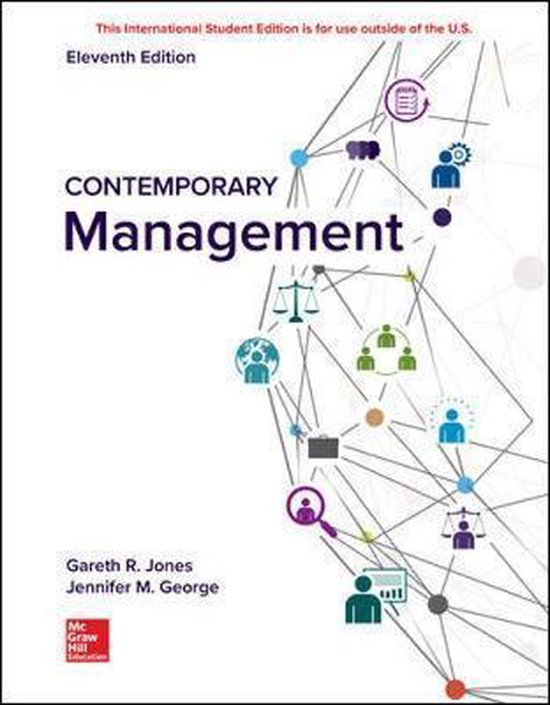
Contemporary Management, Gareth R.
Jones, Jennifer M. George summary
Chapter 1: Managers and managing
This chapter explains who managers are, what they do and what skills they have to
posses. You will also learn about levels of managers and changes in management
practices today, and the challenges managers face in the global environment.
Organizations - collections, groups of people working together and coordinating their
actions to achieve common goals or desired future outcomes.
Management - planning, organizing, leading and controlling resources to achieve
organizational goals efficiently and effectively. Resources include: money, raw
materials, experience, people, knowhow, computers, patents...
Achieving high performance: A manager’s goal
Organizational performance -a measure how efficiently and effectively resources are
being used to satisfy customers and achieve organizational goals.
Effectiveness means doing right things. It is a measure of how appropriate are the
goals managers have selected for the company. Efficiency means doing things right. It
is a measure of how productively resources are used to achieve a goal.
Companies with low effectiveness and low efficiency are choosing wrong goals and
are are using their resources poorly. The result is a low quality product that no one
wants.
Companies with high efficiency, but low effectiveness are producing high quality
products that no one wants because they chose a wrong goal, but they have managed
their resources well.
Companies with low efficiency, but high effectiveness creates a high quality product
that no one can afford.
Companies that achieve both, high efficiency and high effectiveness are producing
high quality products that customers want and can afford.
1
,4 Essential managerial tasks
1. Planning - selecting appropriate goals and future outcomes. It includes: deciding
what goals we want to achieve; deciding what strategy to use to get there;
allocating resources to pursue strategies needed to reach those goals.
2. Organizing - organizing relationships between employees (or any other
organization members) so they can cooperate and achieve common goals. The
outcome of organizing is the creation of the organizational structure - a formal
system of task and reporting relationships that coordinates and motivates
employees (or any other organization members) to work together on achieving
common goals.
3. Leading - articulating a clear organizational vision for the organization’s
members to accomplish, and energizing and enabling employees to understand
the part he/she plays in achieving organization’s goals.
Organization’s vision - a short, succinct, and inspiring statement of
company’s desired future state, what the organization intends to become and
the goals it is seeking to achieve.
4. Controlling - evaluating how well an organization is achieving its goals and
taking action to maintain or improve performance.
Managerial roles identified by Mintzberg
Interpersonal:
Figurehead - Acts in charge, even if the power lies with someone else. Has social
roles such as opening new headquarters
Leader - Motivates and mobilizes employees for specific goals, gives direct
commands and orders, provides an example for employees to follow
Liaison - Coordinates the work of managers of different departments to share
resources to produce new goods and services.
Informational:
2
, Monitor - Watches for changes in internal and external environments that could
affect the organization, evaluates the work of employees and managers in
different departments and takes corrective action if necessary.
Disseminator - Communicates the vision and purpose to employees, and informs
them about changes in the internal and external environments that could affect
them.
Spokesperson - Launches national marketing campaigns to promote new goods
and services, informs local communities about future intentions of the
organization.
Decisional:
Entrepreneur - Commits resources for developing new products and services,
makes decisions about international expansion.
Disturbance handler - Takes quick corrective actions to protect the organization
from the unexpected problems from the external environment (eg. Oil spills), or
from internal problems (producing faulty goods or services)
Resource allocator - Sets budgets and salaries for middle and first-level
managers, allocates resources to different departments
Negotiator - Works with suppliers, distributors, labor unions and other
organizations to reach agreements about the quality and the price of resources,
common projects etc.
Levels and skills of managers
Department - A group of people that use similar skills, knowledge and tools to
perform their jobs.
Levels of management
First-line managers (supervisors) - Forming a base of the managerial hierarchy, they
are responsible for daily supervision of nonmenagerial employees (leading is the
predominant managerial task)
Middle managers - Responsible for allocating resources to achieve organization’s
goals, and supervising first-line managers (leading and planning predominant tasks)
3
, Top managers - Monitor the performance of middle managers and decides how all
departments should interact to achieve goals (Planning is the predominant task)
Chief executive officer (CEO) - Company’s most senior and important manager, the
one that all managers report to. Responsible for the creation of the top management
team.
Top management team - Group consisting of the CEO, Chief Operating Officer
(COO) and the vice presidents, responsible for achieving organization’s goals.
Managerial skills
Conceptual skills - Ability to analyze the situation and to distinguish the cause and
effect, and right and wrong.
Human skills - Ability to lead, and to understand, alter and control the behavior of
others.
Technical skills - Job-specific skills required to perform a particular type of work at a
high level.
Core competency - Specific set of skills, experiences and knowledge that allows one
company to outperform others.
Competitive advantage - a factor that allows companies to outperform their
competition.
Recent changes in management practices
Two major factors that led to changes in management practices are global competition
and advances in IT.
Restructuring and outsourcing
To utilize IT and increase efficiency and effectiveness, managers made certain
changes:
Restructuring - Simplifying, downsizing and/or shrinking an organization’s operations
to lower costs. It can be accomplished by eliminating product teams, shrinking
departments and reducing levels in the hierarchy. Negative sides of restructuring are:
4
Jones, Jennifer M. George summary
Chapter 1: Managers and managing
This chapter explains who managers are, what they do and what skills they have to
posses. You will also learn about levels of managers and changes in management
practices today, and the challenges managers face in the global environment.
Organizations - collections, groups of people working together and coordinating their
actions to achieve common goals or desired future outcomes.
Management - planning, organizing, leading and controlling resources to achieve
organizational goals efficiently and effectively. Resources include: money, raw
materials, experience, people, knowhow, computers, patents...
Achieving high performance: A manager’s goal
Organizational performance -a measure how efficiently and effectively resources are
being used to satisfy customers and achieve organizational goals.
Effectiveness means doing right things. It is a measure of how appropriate are the
goals managers have selected for the company. Efficiency means doing things right. It
is a measure of how productively resources are used to achieve a goal.
Companies with low effectiveness and low efficiency are choosing wrong goals and
are are using their resources poorly. The result is a low quality product that no one
wants.
Companies with high efficiency, but low effectiveness are producing high quality
products that no one wants because they chose a wrong goal, but they have managed
their resources well.
Companies with low efficiency, but high effectiveness creates a high quality product
that no one can afford.
Companies that achieve both, high efficiency and high effectiveness are producing
high quality products that customers want and can afford.
1
,4 Essential managerial tasks
1. Planning - selecting appropriate goals and future outcomes. It includes: deciding
what goals we want to achieve; deciding what strategy to use to get there;
allocating resources to pursue strategies needed to reach those goals.
2. Organizing - organizing relationships between employees (or any other
organization members) so they can cooperate and achieve common goals. The
outcome of organizing is the creation of the organizational structure - a formal
system of task and reporting relationships that coordinates and motivates
employees (or any other organization members) to work together on achieving
common goals.
3. Leading - articulating a clear organizational vision for the organization’s
members to accomplish, and energizing and enabling employees to understand
the part he/she plays in achieving organization’s goals.
Organization’s vision - a short, succinct, and inspiring statement of
company’s desired future state, what the organization intends to become and
the goals it is seeking to achieve.
4. Controlling - evaluating how well an organization is achieving its goals and
taking action to maintain or improve performance.
Managerial roles identified by Mintzberg
Interpersonal:
Figurehead - Acts in charge, even if the power lies with someone else. Has social
roles such as opening new headquarters
Leader - Motivates and mobilizes employees for specific goals, gives direct
commands and orders, provides an example for employees to follow
Liaison - Coordinates the work of managers of different departments to share
resources to produce new goods and services.
Informational:
2
, Monitor - Watches for changes in internal and external environments that could
affect the organization, evaluates the work of employees and managers in
different departments and takes corrective action if necessary.
Disseminator - Communicates the vision and purpose to employees, and informs
them about changes in the internal and external environments that could affect
them.
Spokesperson - Launches national marketing campaigns to promote new goods
and services, informs local communities about future intentions of the
organization.
Decisional:
Entrepreneur - Commits resources for developing new products and services,
makes decisions about international expansion.
Disturbance handler - Takes quick corrective actions to protect the organization
from the unexpected problems from the external environment (eg. Oil spills), or
from internal problems (producing faulty goods or services)
Resource allocator - Sets budgets and salaries for middle and first-level
managers, allocates resources to different departments
Negotiator - Works with suppliers, distributors, labor unions and other
organizations to reach agreements about the quality and the price of resources,
common projects etc.
Levels and skills of managers
Department - A group of people that use similar skills, knowledge and tools to
perform their jobs.
Levels of management
First-line managers (supervisors) - Forming a base of the managerial hierarchy, they
are responsible for daily supervision of nonmenagerial employees (leading is the
predominant managerial task)
Middle managers - Responsible for allocating resources to achieve organization’s
goals, and supervising first-line managers (leading and planning predominant tasks)
3
, Top managers - Monitor the performance of middle managers and decides how all
departments should interact to achieve goals (Planning is the predominant task)
Chief executive officer (CEO) - Company’s most senior and important manager, the
one that all managers report to. Responsible for the creation of the top management
team.
Top management team - Group consisting of the CEO, Chief Operating Officer
(COO) and the vice presidents, responsible for achieving organization’s goals.
Managerial skills
Conceptual skills - Ability to analyze the situation and to distinguish the cause and
effect, and right and wrong.
Human skills - Ability to lead, and to understand, alter and control the behavior of
others.
Technical skills - Job-specific skills required to perform a particular type of work at a
high level.
Core competency - Specific set of skills, experiences and knowledge that allows one
company to outperform others.
Competitive advantage - a factor that allows companies to outperform their
competition.
Recent changes in management practices
Two major factors that led to changes in management practices are global competition
and advances in IT.
Restructuring and outsourcing
To utilize IT and increase efficiency and effectiveness, managers made certain
changes:
Restructuring - Simplifying, downsizing and/or shrinking an organization’s operations
to lower costs. It can be accomplished by eliminating product teams, shrinking
departments and reducing levels in the hierarchy. Negative sides of restructuring are:
4