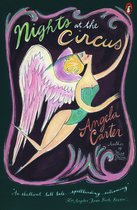
Angela Carter- Nights at the Circus
(1) I have always used a very wide number of references because of tending to regard all of
western Europe as a great scrap-yard from which you can assemble all sorts of new
vehicles…bricolage. Basically, all the elements which are available are to do with the margin
of the imaginative life, which is in fact what gives reality to our own experience, and in which
we measure our own reality.
-John Haffenden, ‘Angela Carter’, in Novelists in Interview (London: Methuen, 1985), pp. 76-
96 (p. 92).
Carter treats European literature like a scrapyard > to create a new patchwork text.
Carter is concerned with the marginal/ eccentric position.
Carter interested in the way literature can shape cultural ideas on gender etc.
(2) This investigation of the social fictions that regulate our lives […] is what I’ve concerned
myself with. […] I believe that all myths are products of the human mind and reflect only
aspects of material human practice. I’m in the demythologising business.
Angela Carter, ‘Notes From the Front Line,’ in On Gender and Writing, ed. Michelene Wandor
(London: Pandora, 1983), pp. 69-77 (pp. 70-71).
Carter’s writing- is decolonising particular habits of thought:
(3) I try, when I write fiction, to think on my feet – to present a number of propositions in a
variety of different ways, and to leave the reader to construct her own fiction for herself from
the elements of my fictions. (Reading is just as creative an activity as writing and most
intellectual development depends upon new readings of old texts. I am all for putting new
wine in old bottles, especially if the pressure of the new wine makes the old bottles
explode.)
Carter, ‘Notes from the Front Line,’ p. 69.
Carter is concerned with anti-realist modes of representation, which disrupt classic
realism.
Carter’s fiction is postmodern:
(4) Simplifying to the extreme, I define postmodern as incredulity toward metanarratives.
Jean-Francois Lyotard, The Postmodern Condition: A Report on Knowledge
(Minneapolis: University of Minnesota Press, 1984), p. Xxiv
A collapse of grand narratives- part of postmodernism. Reality is no longer about a grand
narrative, but about a multitude of competing small narratives > more fragmented/
complex/ competing ways of understanding the world > about disrupting master
narratives.
Carter emerged from a line of female MR storytellers (5)
Carter is keen to distance herself from Marquez and MR.
Circus- covers up horrific realities of everyday life > used to critique a social reality.
3 MR aspects: 1. Treatment of boundaries- precarious/transgressive 2. MR bodies- e.g.
Fevvers 3. Temporal and spatial shifts.
Set on a temporal boundary. A world of uncertainty- centred around Fevvers- is she fact
or is she fiction?
Idea of women taking flight- cf. Clara on rocking chair- like Trapeze.
MR body- human and animal- taking flight from and using mythological figures.
A woman who defies reality- how can she exist?
Walser- aim is to discover truth of Fevvers- presumes she is a ‘humbug’ of the world.
Fevvers, the most famous aerialiste of the day; her slogan, ‘Is she fact or is she fiction?’ And
she didn’t let you forget it for a minute; this query, in the French language, in foot-high letters,
blazed forth from a wall-size poster, souvenir of her Parisian triumphs, dominating her London
(1) I have always used a very wide number of references because of tending to regard all of
western Europe as a great scrap-yard from which you can assemble all sorts of new
vehicles…bricolage. Basically, all the elements which are available are to do with the margin
of the imaginative life, which is in fact what gives reality to our own experience, and in which
we measure our own reality.
-John Haffenden, ‘Angela Carter’, in Novelists in Interview (London: Methuen, 1985), pp. 76-
96 (p. 92).
Carter treats European literature like a scrapyard > to create a new patchwork text.
Carter is concerned with the marginal/ eccentric position.
Carter interested in the way literature can shape cultural ideas on gender etc.
(2) This investigation of the social fictions that regulate our lives […] is what I’ve concerned
myself with. […] I believe that all myths are products of the human mind and reflect only
aspects of material human practice. I’m in the demythologising business.
Angela Carter, ‘Notes From the Front Line,’ in On Gender and Writing, ed. Michelene Wandor
(London: Pandora, 1983), pp. 69-77 (pp. 70-71).
Carter’s writing- is decolonising particular habits of thought:
(3) I try, when I write fiction, to think on my feet – to present a number of propositions in a
variety of different ways, and to leave the reader to construct her own fiction for herself from
the elements of my fictions. (Reading is just as creative an activity as writing and most
intellectual development depends upon new readings of old texts. I am all for putting new
wine in old bottles, especially if the pressure of the new wine makes the old bottles
explode.)
Carter, ‘Notes from the Front Line,’ p. 69.
Carter is concerned with anti-realist modes of representation, which disrupt classic
realism.
Carter’s fiction is postmodern:
(4) Simplifying to the extreme, I define postmodern as incredulity toward metanarratives.
Jean-Francois Lyotard, The Postmodern Condition: A Report on Knowledge
(Minneapolis: University of Minnesota Press, 1984), p. Xxiv
A collapse of grand narratives- part of postmodernism. Reality is no longer about a grand
narrative, but about a multitude of competing small narratives > more fragmented/
complex/ competing ways of understanding the world > about disrupting master
narratives.
Carter emerged from a line of female MR storytellers (5)
Carter is keen to distance herself from Marquez and MR.
Circus- covers up horrific realities of everyday life > used to critique a social reality.
3 MR aspects: 1. Treatment of boundaries- precarious/transgressive 2. MR bodies- e.g.
Fevvers 3. Temporal and spatial shifts.
Set on a temporal boundary. A world of uncertainty- centred around Fevvers- is she fact
or is she fiction?
Idea of women taking flight- cf. Clara on rocking chair- like Trapeze.
MR body- human and animal- taking flight from and using mythological figures.
A woman who defies reality- how can she exist?
Walser- aim is to discover truth of Fevvers- presumes she is a ‘humbug’ of the world.
Fevvers, the most famous aerialiste of the day; her slogan, ‘Is she fact or is she fiction?’ And
she didn’t let you forget it for a minute; this query, in the French language, in foot-high letters,
blazed forth from a wall-size poster, souvenir of her Parisian triumphs, dominating her London